
Why should sustainability and circularity be a focus?
The UK’s 30 million homes contribute approximately 16% of national carbon emissions, with around three-quarters of these emissions resulting from heating systems. Numerous reports have been published in recent years outlining the reasons for retrofitting.
- The Royal Institute of Chartered Surveyors (RICS)
- Low Energy Transformation Initiative (LETI)
- UK Green Building Council (UKGBC)
- The Committee on Climate Change (CCC)
- The Institute of Civil Engineers (ICE)
- The Institution of Engineering & Technology (IET)
Sustainability in retrofit is often reduced to improving energy efficiency; however, this only tackles the operational impact, which is only one aspect of the sustainability context surrounding retrofit.
Embodied carbon is often overlooked, this includes emissions associated with manufacturing, transporting, installing, and ultimately disposal of materials.
A sustainable retrofit should balance these two factors and ensure that short term gains (e.g. EPC improvement) don’t interfere with long term goals (e.g. reducing our lifetime carbon environmental impact).
Fundamentally, the UK has committed to a 100% reduction in net greenhouse gas emissions by 2050 and housing is a sector that is ripe for improvement to facilitate this goal.
Sustainability imperative
Why retrofit matters
As of 2018, the domestic sector uses 480TWh (terawatt-hours) of energy each year, with the majority of this going to heat and providing hot water for our homes.
Natural gas is currently our primary source of energy within the home (84%).
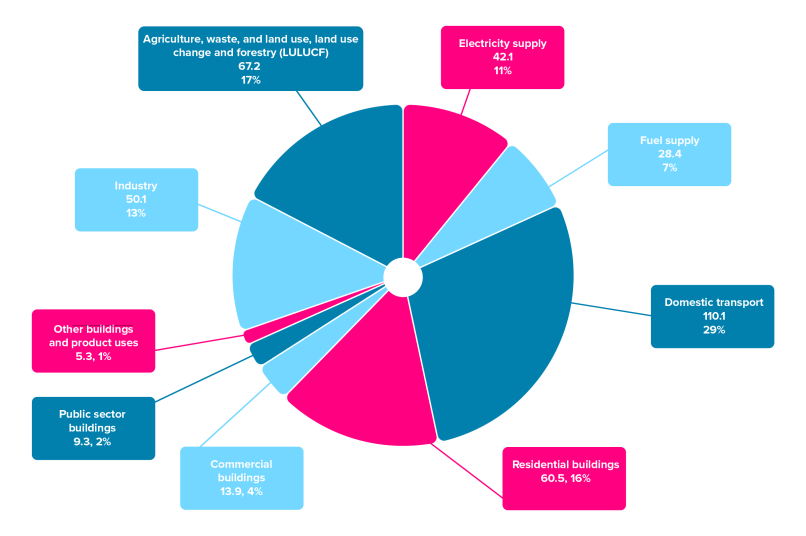
According to government statistics, it is estimated that in 2024 residential emissions (adjusted for temperature) accounted for 60.5 MtCO2e (Million tonnes of CO₂ equivalent), 16% of the UK’s cumulative 386.9 MtCO2e .
Retrofitting addresses the performance of existing buildings; additionally, considering that 80% of houses in existence today will exist in 2050|Xqs, this also accounts for a huge proportion of the future housing stock and its operational emissions. This however only tells a part of the sustainability story; understanding the full picture requires a whole-life approach that considers the environmental impact of materials, manufacturing, installation, and end-of-life scenarios.
Lifecycle thinking
Traditional retrofit strategies have focussed on operational energy savings but this considered in isolation can lead to unintended consequences.
An example of this would be installing high performance materials with high embodied carbon, which may reduce heating demand, but increase the building’s overall carbon footprint due to the carbon cost of manufacture of the material, or its incompatibility with reuse or recycling.
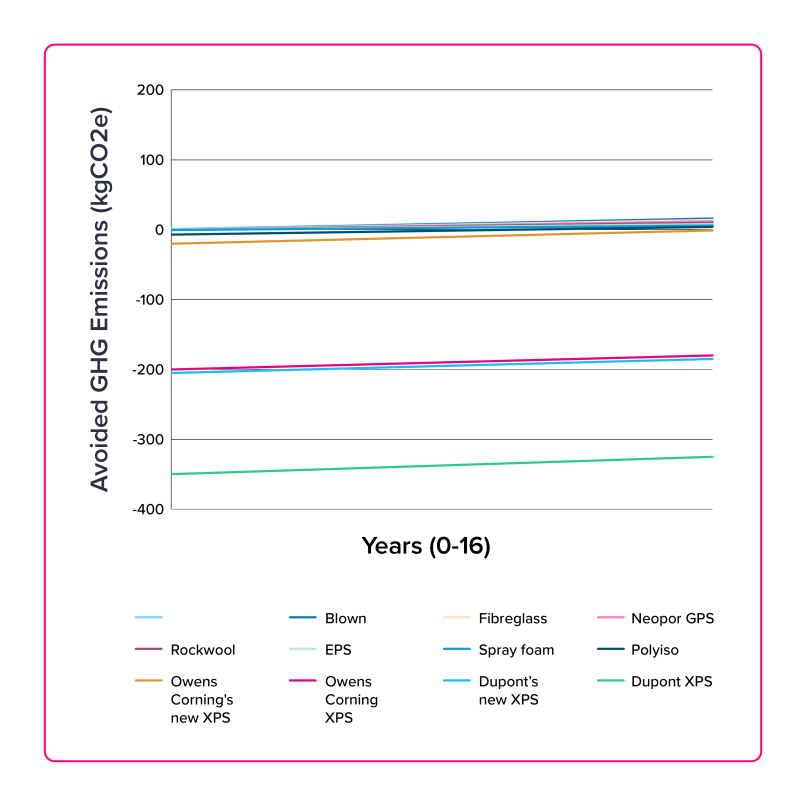
In the electric heat pump scenario, it is not reasonable to expect the operational carbon savings to ever outweigh the embodied carbon of the material [XPS] itself.
A real-life example of this would be XPS, which has between 5x – 50x the Global Warming Potential (GWP) of Rockwool’s mineral wool insulation. Figure 2 shows the payback of different insulation materials and illustrates the considerable time period to achieve “break even” with XPS.
Circular economy principles for retrofit
The Ellen Macarthur Foundation define a circular economy as “…a system where materials never become waste and nature is regenerated”.
In a circular economy, products and materials are kept in circulation through processes like maintenance, reuse, refurbishment, remanufacture, recycling, and composting.
The Circular Economy is based on three principles:
1. The elimination of waste and pollution
2. The circulation of products and materials at their highest value
3. The regeneration of nature.
Retrofit has clear positive impact regarding principles 1 and 2. At its core, retrofit is about preserving the (housing) resources we already have, and upgrading them to reduce/eliminate waste and pollution through operation.
An assessment led by the University of Liverpool shows the carbon cost of demolition to be in the magnitude of 1-10 tCO2e per building. However, they also estimate the carbon cost of materials (brick and timber) to equal 75.3t tCO2e, or 0.2 tCO2e per m2 of total floor area.
They conclude that these carbon costs alone represent more than the embodied carbon within a deep retrofit (EnerPHit Plus). This finding is backed by research carried out by UCL comparing retrofitting vs. the demolition and rebuilding of a new, low energy home.
Their findings show that lifetime emissions in the latter case are 6% more than the retrofit option, and carries an additional £52,800 cost.
If Carbon reduction is the primary driver, demolition and new build costs £230 more per tonne of emissions compared to retrofit.
Practical strategies
Material reuse
Currently less than 1% of building materials are reused at the end of their useful life. The remaining concrete, steel, and other valuable materials become waste, despite these materials still being produced for other buildings.
According to studies carried out by McKinsey, circularity principles – and specifically reuse of building materials – could abate 13% of the built environment’s emissions in 2030 and 75% in 2050.
Design for disassembly principles can be applied to buildings so that material reuse can be built in at the design phase.
Case study – The Forge, Bankside

Material passports
Material passports serve as comprehensive records that catalogue the materials, products, and components used in buildings. They include essential data such as material composition, origin, environmental impact, and potential for reuse or recycling.
This information is crucial for facilitating circular thinking in construction, allowing for efficient deconstruction, recovery, and repurposing of materials at the end of their life cycle. The benefits of this are:
- Enhancing reuse and recycling strategies by identifying valuable materials and providing strategies for end of life/second life.
- Facilitation of “Material Banks”: they can connect to online marketplaces, allowing the buying and selling of reclaimed materials, thus supporting a circular economy.
- Data accessibility: material passports centralise important data, making it easier for architects, builders, and recyclers to access information about materials, certifications, and environmental impacts.
Future outlook and innovation
Emerging innovation
- Bio-based insulation such as hemp, cork, cellulose, and straw-based insulation. These products are not ‘new’ but are yet to be adopted widely across the industry. They offer low embodied carbon, particularly when considering the biogenic carbon storage potential of these products.
- Reverse logistics – systems for reclaiming and reusing construction materials – are emerging as a method to streamline the capture and reuse of building materials. In retrofit specifically, the use of delivery logistics to reclaim deconstructed building materials.
- Active buildings are structures that integrate intelligent renewable energy technologies for heat and power to support the wider energy grid. The concept is underpinned by efficient building fabric, passive design, and clean renewable energy that outperforms the requirement of the building itself. These systems can be integrated into active communities where multiple active buildings are connected, providing flexible support to the local or national electricity grid.