Current state pains and barriers
Pains
Barriers
This chapter covers the skills and labour required to deliver retrofit at scale, including identifying the expected future labour demands, and the associated skills that the workforce will require to deliver retrofits.
Additionally, the chapter seeks to showcase current skills pathways for students, apprentices, and professionals transitioning into the retrofit market.
It also examines the limitations within the construction sector regarding its capacity to meet growing personnel and skills demands, and discusses strategies for bridging these gaps in the future.
Transform-ER partner MTC have led research into this as part of the project.
Current state
The following points have been outlined to summarise the current state of labour and skills for retrofit:
Capacity and volume of workforce
- The Connected Places Catapult has estimated that 200,000 people are currently working on maintaining and upgrading existing homes and that there is a need for 400,000 additional skilled professionals to meet net zero 2050 goals for retrofit.
- It is estimated that 86,000 retrofit co-ordinators, 27,000 building envelope specialists, and 59,000 plumbers and HVAC professionals will be needed to meet demand, highlighting the need for upskilling and training at pace.
- There is an increase in demand on construction professionals across the industry. It is estimated that to meet government targets, including building of 300,000 homes per year and building of government assets, around 225,000 extra construction workers are needed – this is not including additional demand from retrofit delivery increases.
- Places for People have calculated that there are currently 140,000 vacancies in the construction sector. We are unable to fulfil existing workforce vacancies, therefore as demand for construction professionals increases, this problem will only worsen.
- The UK construction workforce is aging. By 2035 we will lose over one third of our existing workforce to retirement, therefore there is an even greater increase on labour requirements, just to maintain employment levels in the sector.
Awareness of Retrofit Demand
- Retrofit is not talked about as frequently as new build construction, so career opportunities in the area are less known about.
- The role of retrofit in achieving net zero by 2050 is not discussed with the same prominence as other facilitators of these goals – such as renewable energy generation.
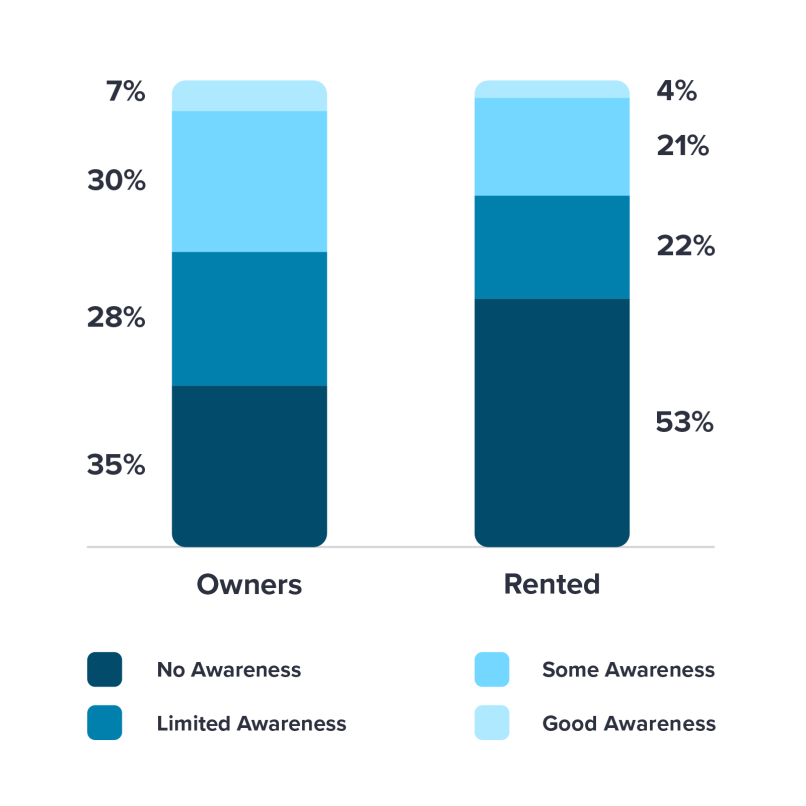
- GLA Opinion Research found that over half (56%) of Londoners have heard of the term ‘retrofitting’, though only 30% of Londoners know at least a little bit about it whereas 26% have heard of it but don’t know anything about it.
- It was discovered that tenure has an impact on the awareness of retrofit as seen in Figure 1.
Access to and quality of training
- While there is a range of retrofit training available, there is a lack of clarity as to what is necessary, as well as who should receive what training.
- The National Retrofit Hub has created a Qualifications and Training Map, which outlines a varied breadth of training. There is a need for standardised content and format of training, clear guidance on who can provide it, or what standard it meets from a national qualification’s perspective.
Increased breadth of knowledge required
- All trades involved in retrofit require at least a basic understanding of the holistic retrofit process to ensure they are aware of key interfacing requirements between their part of the build and other suppliers of EEMs.
- Heritage and older properties are often not covered in retrofit-specific or in general construction training courses, meaning even those with appropriate training may not actually possess the skills required to complete a significant proportion of retrofits. See also retrofitting heritage buildings toolkit.
Lack of proof of competency to carry out retrofit tasks
- The CLC Roadmap of skills for net zero sets out some of the existing methods for proving competency (listed below) – and while PAS 2030 is mandatory for all social housing or government schemes, the required proof of competency is not a standardised form across retrofit. Example schemes include:
- Competent persons schemes
- PAS 2030 retrofit installer scheme – required for social housing and government backed retrofits.
- TrustMark
- Construction Skills Certification Scheme
Localised requirements for skillsets
- Typical construction projects rely on a subcontracting supply chain model, which means that skills for retrofit will be required near to site delivery, sometimes in remote locations and areas.
Customer/Resident Communication Skills
- ‘Soft skills’ required for tenant liaison are often not as well developed within the construction sector leading to lower take-up and acceptance of retrofit procedures.
Fragmented supply chain
- Retrofit supply chains often comprise large numbers of small businesses and SMEs. This can place additional strain on co-ordination and Quality Control (QC) measures for retrofit work.
Future state
To remedy the issues outlined for labour and skills, the following three areas should be in focus:
Inspire the future workforce and increase awareness
- New entrants are required in the construction industry to keep up with an increasing labour demand. To apply this to retrofit, the positives need to be clearly signposted at an early stage through vocational courses and pathways such as apprenticeships. The potential career and development opportunities in construction and retrofit professions should be clearly mapped out.
- Awareness needs to be raised about the importance of retrofit and accelerating the upskilling of existing labour and professionals in the construction industry.
Provide training to new and existing construction professionals for retrofit
- Clear pathways should be provided illustrating the skills required to work on specific Energy Efficiency Measures (EEMs), as well as generalised retrofit training that all industry actors should be aware of.
Set minimum competency standards for retrofit professionals
- Universal competency standards should be set for specific EEMs, making it clear what professionals must adhere to, and what training is required.
Getting from here to there
Questions
- Who will govern retrofit skills and competency?
- Who should take a lead on harmonising training and skills frameworks to a national standard?
- Should we – and how do we – move away from the existing contracting model?
Enablers
- NRH qualifications and training map
- Training platforms such – GetZero
- UK consensus on skills and competencies required – national standard.
Key insights
- Generally, the construction sector as a whole needs to ensure it is shining in a positive light as a place to work – it’s the only way to encourage new life into the sector and fill the existing and future skills gaps!