
Current state pains and barriers
Pains
Barriers
Current state
As documented in the Transform-ER Define the Need report and capturing other options emerging in retrofit, current retrofit strategies include:
Shallow retrofit
- Focus: Aims to improve energy efficiency and comfort with minimal disruption and cost; focusing on easy, low-cost upgrades.
- Scope: Targets quick fixes that provide immediate – though limited – improvements in energy efficiency.
Fabric first approach
- Focus: Prioritises enhancing the building’s fabric (walls, roof, floors, doors, windows) before addressing mechanical systems.
- Scope: Optimises the building envelope reduces energy consumption, allowing mechanical systems to be smaller and more efficient.
Whole-house retrofit/deep retrofit
- Focus: A deep and holistic upgrade to the entire home, improving energy efficiency, comfort, health, and resilience (e.g. homes exposed to severe weather conditions). It entails a comprehensive plan that considers all aspects of the building such as air quality, ventilation, occupants’ activity, and use of the house.
- Scope: Includes energy efficiency upgrades, indoor air quality improvements, water usage optimisation, and occupant comfort enhancements, treating the home as a system.
- Case Study: Passivhaus EnerPHit , Energiesprong
Smart energy systems approach
- Focus: Prioritises decarbonising the energy systems within a property by relying on electrical systems powered with renewable energy.
- Scope: This involves minimal fabric improvements; and increased adoption of renewable energy, battery storage, smart tariffs, and electrified heat.
Fabric fifth approach
- Focus: offers an alternative view to the Fabric First approach, outlining that fabric measures are still important but should be de-prioritised due to payback on investment and embodied carbon.
- Scope: order of retrofit – 1. Air-Source Heat Pumps, 2. Smart Controls and Meters, 3. Measure and Optimise comfort through low-cost measures, 4. Solar & Storage, 5. Fabric Fifth
- Source: Fabric Fifth
Step-by-step phased retrofit
- Focus: takes a long-term view, considering different Government funding initiatives, and how a deep-retrofit can be achieved in a sequential, step by step process to match finance and funding options.
- Scope: whole house/deep retrofit in different phases over time
- Sources:
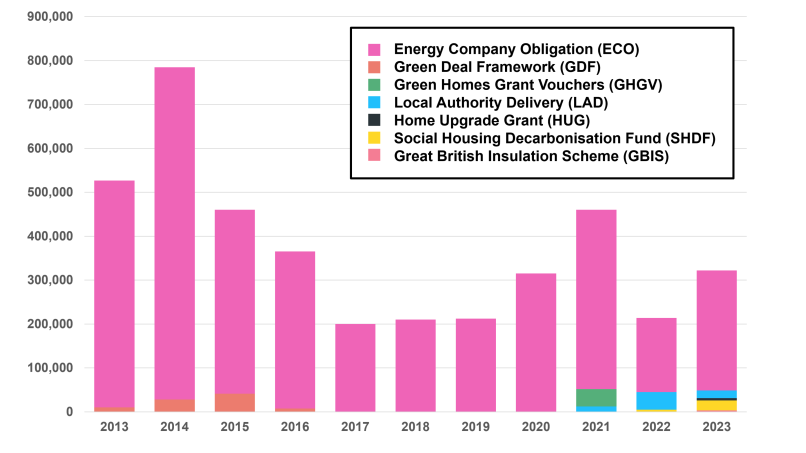
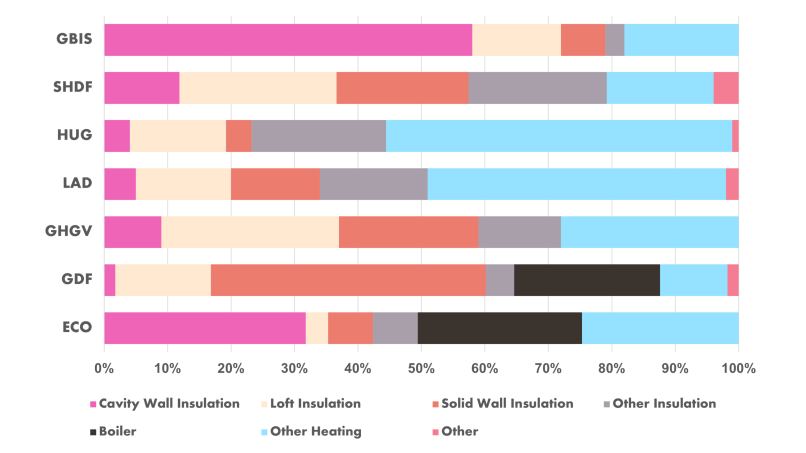
There are many challenges in matching the different Retrofit strategies organisations could take as part of the UK and global Net Zero pathway, including:
- The short-term nature and differing scope of Government funding initiatives makes it difficult for retrofit organisations to form a long-term plan of action for implementing retrofit at scale.
- One-offs or pilot projects, without considering building an accurate picture of pipeline demand and grouping similar dwellings together for scale of delivery.
- As discussed in the Project risk, finance and insurance chapter, there can be challenges in developing a sound business case in terms of payback on investment and embodied carbon.
- This has seen the recent emergence of “Fabric Fifth” as an option in the industry vs “Fabric First”.
Future state
The following has been identified to develop the future state of retrofit at scale:
- To outline a clear Pipeline Demand for scaling retrofit, align existing and future funding initiatives, and outline a net zero pathway for a portfolio of properties, a best practice archetyping approach is recommended:
- Clear and long-term funding initiatives from the UK Government to support net zero pathways for organisations, to give confidence that retrofit is at the heart of Government policy in the long-term.
- Linking funding to long-term public retrofit funding and private finance.
- Building scalable portfolios of properties to move communities and areas of the UK towards net zero
- To form a long-term plan for retrofitting at scale, a sound business case should be formed – outlining the chosen retrofit strategy, value proposition, payback on investment, and plan for public and private finance in future.