

Current state pains and barriers
Pains
- Limited diversity of products that are certified in accordance with PAS 2035 and Trustmark.
- UK building stock is one of the most diverse in Europe. Products must be highly adaptable to meet the demands of the range of archetypes and variations.
Barriers
- Current products have performance uncertainty and often fail to achieve the modelled energy or functional performance due to inadequate commissioning and monitoring processes.
- Retrofitting frequently demands bespoke solutions, specialised labour and downtime all of which increase capital expenditure.
Overview
The current retrofit landscape is held back by fragmented, non-standardised products, supply-chain and skills constraints, and slow innovation. This can result in higher costs, poor scalability, and significant performance and installation challenges across key technologies like solar, heat pumps, glazing and insulation.
Key insights:
- There is an inherent lack of modular, scalable and interoperable solutions, manufactured from different suppliers/vendors, that can be deployed efficiently and interchangeably across a diverse range of housing archetypes.
- Redundant engineering effort is common because calculations, detailing and coordination are repeated across similar projects.
- A lack of standardisation prevents the use of automated design tools.
- Scalability is limited because retrofits remain bespoke and aren’t manufactured at scale, optimising throughput to meet forecasted retrofit demand.
- The cost of parts and products is elevated due to low production volumes and increased delivery lead times caused by limited stock levels.
In general, construction products are easier to design and develop for new builds. This is due to the unpredictable condition of existing building stock, and requirement for bespoke details to accommodate a variation of dimensions and features.
Retrofitting older buildings
Older buildings, which account for approximately 20% of the UK’s dwellings stock, are incompatible with modern retrofit products*. This can be attributed to the following factors:
- added installation complexity due to construction type and age
- incompatible products causing moisture build-up or fabric decay
- use of non-traditional materials on historic fabric
- planning compatibility with heritage listed buildings and those in conservation areas
- visible alterations.

Added complexities
Retrofit products deal with a lot of unforeseen site conditions which when discovered can cause delays and cost overruns, such as hidden defects, undocumented modifications or hazardous materials.
Therefore, the development of innovative retrofit solutions involves significant upfront investment of time, resource and capital.
Once products are close to market, the requirement to navigate an unclear testing and certification landscape creates further complexities.
- Product innovation is not keeping pace with the policy ambition or scale of retrofit required to meet 2050 net zero targets.
- New products often suffer from lacking the necessary support to repair or replace components due to limited experience of products or systems.
- Lead times for new or innovative products can be significant. Fluctuation in demand may cause manufacturing delays – it is important to engage suppliers early to reduce risk of occurrence.
Performance gap
There is significant and well researched “performance gap” acknowledged within the retrofit sector driven by the difference between theoretical and in-situ performance of energy efficiency measures. This is often caused by:
- assumptions of theoretical design (idealised conditions, simplified models)
- variability in existing conditions (building degradation, tolerances and hidden defects or modifications)
- application, different types of building, size of building affecting load factor and efficiency
- poor installation of products and workmanship
- real vs assumed material properties and environmental effects
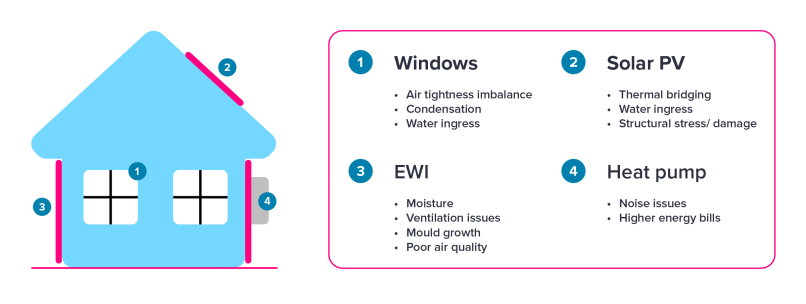
- interplay of measures leading to unintended consequences such as damp or mould.
- limitations of performance certification leading to pressure on manufacturers to perform at particular design points rather than ‘real-world’ conditions.
Products lack embedded integration of monitoring technology to enable real-time performance validation, have poor integration with smart home platforms, proprietary communication protocols and lack interoperability with Building Information Modelling (BIM).
Failure to consider retrofit products as an integrated system can result in isolated or compounded unintended consequences affecting building performance.
Product specific current state
Solar
The UK has a strong R&D landscape across many solar PV and solar thermal technologies, services and processes, but upscaling these new technologies to commercialisation and manufacturing is proving challenging. Many companies are seeking to locate plants overseas.
- The UK is highly dependent on solar PV module and inverter imports. The UK should look to diversify its supply chain and invest in UK manufacturing to be resilient. This ensures depth of supply chain options and associated benefits to the UK, such as job creation, onshoring and increased confidence in reaching emissions reduction targets.
- The UK has set an ambitious target of 45-47 GW for solar with a large emphasis on domestic rooftop which should account for 20% of the capacity as of 2030.
- Existing standards and certification are not well suited for the new generation of solar technology such as silicon-perovskite tandem cells. (see A roadmap for tandem photovoltaics for more information). Uncertainty creates constraints and reluctance in development.
- The number of qualified solar installers varies between regions – London is particularly challenging. Despite growing demand from consumers, shortage of trained and accredited installers is a significant barrier to wider adoption.
Heat pumps
UK heat pump technologies exist but remain too expensive for widespread adoption, innovation is required to reduce costs.
- Running cost savings from heat pumps are marginal, hence they have long pay-back periods – making them unattractive to adopters.
- Electricity in the UK is 3 – 4 times more expensive than gas per kWh.
- Coefficient of Performance (COP) can vary from 2.5 to 4 for air-source heat pumps – the measure of its efficiency to transfer to heat from electrical energy consumed.
- UK Government aims to grow the heat pump market to 600,000 installations per year by 2028, followed by 1.9 million in 2035. In 2024 there were c. 45k government supported installations.
- Heat pumps lack the required Smart-Readiness Level capability to allow for their control systems to respond to dynamic tariffs and external signals.
- Installation of heat pumps accounts to 50% of total cost of a heat pump.
- Dwellings often require costly internal plumbing upgrades. Older houses in the UK do not easily accommodate air-to-air systems as in the US and Europe.
- Existing high temperature water-based heat distribution systems in homes are likely not compatible to be retrofitted with lower temperature standard heat pump systems.
Glazing
Over 93% of UK homes have double-glazing windows – most of these are however out-dated or underperform in terms of energy efficiency and insulation.
- There is poor availability of airtight heritage-compatible high-performing glazing.
- There is inconsistent use of recycled materials and no preference for circular economy as uPVC are the most widely used type of frame.
Insulation
- Most insulation and EWI measures are site assembled which increases labour time, cost and quality variability. The current capacity for prefabricated panels is limited which hampers the ability to scale and match retrofit demand.
- The market is lacking lower-cost and lower-disruption solutions for hard-to-treat properties, such as solid wall insulation.
- Insulating these walls often leads to unintended consequences – particularly moisture risk.
- Insulation products lack embedded sensors that detect moisture, temperature and thermal performance.
Future state
How can we achieve a modular, interoperable, and performance-verified retrofit product ecosystem that leverages data, innovation, and smart technologies to accelerate the UK’s transition to high-performance, low-carbon buildings?
Interoperability
Products from different manufacturers should be able to be used seamlessly without requiring bespoke design and while making use of standardised details.
Although in the UK, it is difficult to compete with the low labour cost manufacturing, the nation has excellent R&D technology development capability. The future of retrofit in the UK presents huge opportunity to develop, assemble and install high-tech systems.
Data
Product performance databases are essential to serve as a validated repository of in-use performance data for retrofit products.
- Support the bridging of the performance gap between theoretical design and actual performance.
- Captured empirical data will improve accuracy or energy saving predictions and performance calculations by using validated data.
- Enable benchmarking to identify why actual performance differs from expectations, determine corrective actions, and share best practice.
- Assist in procurement and financing processes by providing verified performance evidence, making products appear less risky to insurers and investors.
- Drive continuous improvement across the supply chain by holding installers and manufacturers accountable for meeting or exceeding performance standards.
Monitoring and real-time performance
Applicable products should incorporate Internet of Things (IoT) sensors to enable real-time performance monitoring and predictive maintenance.
- Sensors support early detection of performance issues and allow occupiers to take precautions.
- Sensors and monitoring devices can validate product performance by collecting real world data.
Battery storage and microgrids
Battery Energy Storage Systems (BESS) that store excess energy generated from onsite renewable sources such as solar PV, that would otherwise be waste, for later use – reduces the need on the grid.
- Use Energy Management Systems (EMS) to control charging and discharging.
- UK infrastructure should adopt more microgrids to improve energy resilience and improve grid flexibility by using ancillary services such as peak shaving, frequency regulation, and voltage support to reduce stress on the national grid. This supports the decarbonisation on the UK’s energy grid by integrating renewables.
Innovations
Several innovations and products are needed to improve the adoption of heat pumps within the UK to progress their feasibility.
- Heat storage products using phase-changing material to enhance grid flexibility and lower costs.
- Development of more functional and maintainable monobloc heat pumps for UK homes to deal with northerly climates.
Heat pumps
Heat pump product design to allow for higher output temperatures would enable them to be integrated with existing radiator systems. This avoids the need for disruptive and costly building refurbishments.
- Development of gas sorption heat pumps (GAHP) would help reduce the demand for electricity, making them more cost efficient in the short to medium term and increase grid resilience.
- New compressor and expander technologies to increase the efficiency of heat pumps.
- Secondary heating phase to increase water temperature into home (direct water heating).
Insulation
The UK should transition towards high performance, space efficient and sustainable insulation technologies. This would lead to:
- Reduction in the use of wet trades which are labour-intensive, slow and weather dependent.
- Adoption of modular factory-finished panels to reduce construction time and build defects.
- Growth of high-performance Aerogel technologies. Ideal for internal wall insulation due to its ultrathin profile and flexible and vapour permeable properties which make it ideal for heritage constrained buildings.
- Increased viability of Vacuum Insulation Panels (VIP) due to the reduction of onsite modifications because of a transition to an offsite manufacturing philosophy and the experience gained from targeted retrofitting of dwelling archetypes
Glazing
To improve the thermal performance of windows in retrofit, advanced novel glazing materials should be developed. These include:
- Low-emissivity coatings which can improve thermal management and energy efficiency by preventing reflecting heat, keeping buildings warmer in winter and cooler in summer.
- Photovoltaic glazing that acts like PV panels. This is useful where roof space or suitability is scarce i.e. flats.
- Installation of triple glazing that offers significantly better U-values than double glazing.
- Development of electrochromic and smart windows that can dynamically adjust their transparency for thermal management of the building envelope. This helps reduce the cooling demand of windows.
Solar
A significant effort to utilise residential roofs is vital to achieve the UK’s ambitious solar PV strategy. Technology capability needs to be accelerated to enable the streamlining of the installation process.
- Integrated PV cells into roof tiles and facades generate electricity without compromising aesthetics. This would help facilitate the adoption of PV in conservation and heritage buildings.
- Rapid deployable roof access systems can increase operational efficiency, especially where scaffolding is expensive and in high demand.
- Automation of solar PV array layouts can maximise energy output using BIM and survey data.
Microinverter adoption over string arrays would optimise PV panel energy output. Microinverters ensure panels are not limited by mismatch losses that may be caused by underperforming panels, dirt or partial shading.
- Increase fault tolerance – if one panel fails the rest operate normally.
- Quickly adapt to changing light conditions due to Maximum Power Point Tracking (MPPT).
- Overall increased system energy production from identical panels – a panels output is not limited by lower performing panels.
- Provide granular monitoring data for each panel.
Getting from there to here
Enablers
- Certification pathways should be aligned with the PAS 2035 framework and integrated within the TrustMark quality assurance scheme.
- Interoperability standards between different product systems.
- Project and performance database developed to help build confidence in current solutions so they can be replicated instead of starting from scratch.
Rules
- All retrofit products should be certified to relevant performance standards (e.g. PAS2035, MCS).
Questions
- How can product innovation be accelerated to meet retrofit requirements and meet the demand required to meet 2050 net zero targets?
- How can monitoring and validation be implemented and embedded into product design?
- How might we increase the energy flow without plumbing modifications for air-to-water systems?
- How might we (as the United Kingdom) tackle the electricity cost crisis in the UK to enable heat pumps to be a more viable technology?
*References:
English Housing Survey live tables, GOV.UK.
Scottish House Condition Survey: 2022 Key Findings – Supporting documents, gov.scot.