
Current state pains and barriers
Pains
Barriers
Overview
Currently, retrofit design is completed on an individual, isolated basis, utilising tailored solutions specific to a particular property or small group of properties.
This leads to high demand for specialist designers and architects to design custom solutions on a one-off basis leading to significant design costs.
The bespoke nature of design leads to costly retrofit delivery and hinders the capability for scale up; and can also potentially reduce accessibility for new product introductions into the market, owing to a reluctance to move away from well-developed, “tried-and-tested” solutions.
Current state
Challenges associated with the current retrofit design process include:
Data availability and quality:
- Lack of availability of existing building data, visuals, performance information, and dimensions; this would allow assessment of building suitability for retrofit and identification of suitable solutions at an early stage.
- There are often unknown elements to homes that prevent completely standardised designs for a given archetype; for example, outbuildings, adjoining walls, and conservatories.
- The scale of the demand pipeline – based on archetype – is currently not very well understood, which prohibits creation of standardised solutions, due to a lack of clarity regarding demand.
- Incorrect or inaccurate building data, which leads to rework and adjustment on site, or multiple measurement and building assessment repeats. These factors increase cost and required time for design work.
Design and architectural resource:
- High level of demand is placed on the expertise and knowledge of retrofit designers to complete unique and bespoke designs.
- Lack of standardisation of components leads to repeated work and additional time required during a project.
- A clear understanding of suitable, market-ready products is required; this is heavily dependent on the experience of the individual designer.
- Experience-based understanding of potential defects, and issues with certain measures or products for specific archetypes.
- Lack of clear methodology for assigning the ownership of interfaces within a design.
Planning and legislation:
- Complexity of planning rules and regulations often result in designs that are suitable in some areas, but may not be suitable for others, leading to rework.
- Processing of planning recommendations and requests can be slow and lead to delays.
- In its retrofit design guidance for PAS 2035, Trustmark outlines “the Scope of Design document and any documentary evidence shall be specific to each individual property” which increases time to create documentation.
Asset owners and landlord collaboration, often retrofit communities have multiple asset owners in a particular area, lack of collaboration across owners can prohibit place-based design solutions limited scalability.
Future state
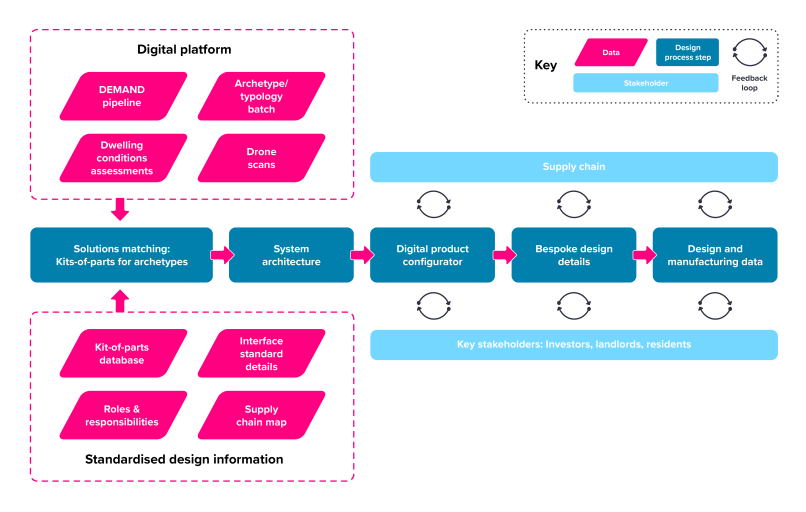
- The future state retrofit design process should employ heavily improved input data, using a digital platform as developed by Ambue on Transform-ER. Digital analysis of pipelines should provide more in-depth property information upfront. This will enable informed decision making; for example, identifying which property archetypes offer the greatest benefits, in a cost-effective manner. This platform, in combination with data collection techniques like Planarific’s drone scanning system, will enable more reliable and complete data sets to guide the design stages of a retrofit.
- A critical aspect of the future of retrofit design is creation of standardised kits-of-parts and interfacing details. By creating suitable retrofit kits-of-parts, based on archetype, that contain all the necessary physical materials to complete a retrofit, the process can become less bespoke and more repeatable. This combined with standard methodologies and pre-approved details for dealing with interfaces should lead to a reduced demand on repeated bespoke design resource, ultimately reducing design costs within retrofit.
- Once kits-of-parts and design details are standardised, there is an opportunity to implement automated design configurators such as the Kope Platform. Using automated configuration further reduces the burden on bespoke retrofit designs, and changes the role of a designer to verifying suitability of configurator outputs rather than the specific repeated design elements. This can unlock greater scaled delivery within retrofit, while also offering easier design customisation, increased scope to facilitate change, and a reduced cost.
- By utilising kits-of-parts and standard interface details, pre-approval of specific retrofit designs can be completed, potentially reducing or negating some of the extant planning issues. Design details can be verified/approved in advance; if these are used repeatably and consistently, planning and legislation delays can be reduced or eliminated.
- The main change within the future state of the retrofit design process is a move towards a holistic end-to-end integrated process in which data flows seamlessly through the whole system. By harnessing early inputs around key building data and product data, the process can become more streamlined and standardised, reducing cost and unlocking retrofit at scale.
Getting from here to there
Questions
- Who owns the centralised system?
- Who are the parties that need to be involved to create a holistic solution/system?
Enablers
- Design details and standardised kits-of-parts from manufacturers.
- Manufacturer collaboration to create standardised and interoperable details.
- Designers providing input to ensure automation is useful and accurate.
Key insights
- End to end solutions offer the opportunity to revolutionise retrofit design, streamlining the process, enabling automation, and ultimately delivering scaled retrofit for affordable prices.
Often retrofit projects are procured as design-and-build (D&B) contracts somewhere in the RIBA Stage 3 to Stage 4 window. We’ve spoken to so many housing portfolio owners and hear the same things – that this go-to model is expensive and doesn’t deliver best value, it’s non-collaborative and they lose control, it doesn’t protect them against costs from abnormals, it doesn’t provide repeatable archetype design or capture learning or scale well, it doesn’t handle community engagement well… the list goes on. It’s just ‘the way things are done’. Isn’t there a better way?! Alex Whitcroft, KIN