

Current state pains and barriers
Pains
Barriers
Overview
This section covers testing and certification for retrofit products and solutions. Transform-ER partners BRE have led research into this as part of the project.
Current state
Key findings from the Retrofit product certification: state of the market report:
Certification routes are complex and time-consuming
- Numerous, seemingly overlapping certification routes create confusion, especially for new market entrants.
- It can be challenging getting new, innovative products recognised within the Government’s Standard Assessment Procedure (SAP) – the tool used to assess the energy performance of dwellings.
Retrofit product certification faces unique challenges, which is stifling innovation
- Existing certifications are not always well-suited for retrofit products, leading to delays in recognition.
- There are no dedicated test standards for many retrofit products, frustrating manufacturers looking for certification.
- PAS2035 and PAS2030, while improving quality in installation, are not intended for product certification.
- Certification has also tightened up recently; there are no longer channels for ‘professional opinions’ to certify a product.
The much-needed move towards integrated energy solutions adds complexity
- Moving towards integrated systems adds complexity to certifications, as multiple performance factors must be considered.
- Manufacturer warranties may not cover integrated systems that diverge from original specifications.
- Fire safety concerns and the new, important Building Safety Act add further certification considerations, especially for innovative solutions.
Current industry standards and the state of the market make it difficult to innovate, test and introduce new products to the market.
Additional to the key findings of this report, other key aspects of the current state have been identified for testing and certification:
- There is a huge jump for manufacturers from early product development through to attempting to pass a test to gain certification. Manufacturers have no steer towards developing solutions effectively before having to fund a full product test, this is also a binary outcome – pass or fail.
- Product developers are currently blind to whether they are proceeding down the correct product development path, e.g. – “is this design feature improving my product for passing a fire test?”
- The investment/costs required to achieve certification can be prohibitive for start-ups/new market entrants.
- The UK has potential bottlenecks in testing and certification, due to the following factors:
- The UK has a limited number of approved test houses, hence is not in a strong position to scale-up testing and certification for retrofit.
- Skilled individuals retiring are not being replaced by new workforce coming through.
- The depth of knowledge required for professionals in testing and certification could add to the skills gap in this area.
- Due to the requirement for impartiality, there are restrictions on guiding advice on areas of knowledge and expertise allowed by certification bodies. Rules of thumb, design guidelines etc cannot be shared that would aid the product development process.
- Organisations and industry standards, such as Trustmark and PAS 2030 and PAS 2035, were rightfully brought in to improve quality control and quality assurance of retrofit. However, these can act as a barrier to innovation:
“While such controls and protections are obviously necessary, these requirements may pose challenges to innovators, and present barriers to market for the solutions that we will need if we are going to meet our ambitious carbon reduction targets.” – Sustainable Energy Association
- BRE is constrained by need for impartiality and independence – they are unable to provide guidance or design rules to pass specific tests and feel “Between rock and a hard place”.
Future state
To reach an ideal future state of Product Testing and Certification, BRE have led research into a Proposal and Route Map for Simplified Route to Certification. Their conclusions and recommendations are:
“While full reform of the certification landscape may be unrealistic in the short term, practical interim solutions exist. The Product Innovator Service, ETVs, and ProMHS for Retrofit could together offer scalable, flexible pathways tailored to different levels of market maturity and innovation.”
Product Innovator Service: suitable for manufacturers seeking guided support and a comprehensive roadmap. The Product Innovator Service is a bespoke, three-phase support framework designed to guide manufacturers through the certification journey with expert assistance from BRE. The service is intended as a “critical friend,” offering clarity, saving time, and reducing errors. However, its costs may deter smaller manufacturers who already face financial strain, and uptake depends heavily on available grants and investment.
Environmental Technical Verification (ETV): valuable for early-stage innovators needing independent verification of a claimed performance. Currently operated by BRE Global under ISO 14034, ETVs provide independent verification that a product performs as claimed, even in the absence of existing product standards. ETVs bridge the gap between unverified innovation and full certification, offering a cost-effective, ISO-recognised alternative
ProMHS for Retrofit: a longer-term strategy for standardising retrofit product evaluation across the sector. Building upon the approach of BRE’s existing “Informed Choices” and ProMHS testing frameworks (for safeguarding in mental health facilities).
“Achieving the UK’s retrofit ambitions will require certification processes that enable, rather than obstruct, innovation. Simplification, collaboration, and mutual trust among regulators, insurers, and manufacturers are key. Transform-ER’s findings provide both a roadmap and a call to action: certification must evolve into a dynamic assurance system that safeguards quality while empowering the pace of retrofit innovation needed to meet net-zero targets.” – BRE.
Additional to the findings of BRE, the following has been identified for an ideal future state, for testing, certification and retrofit at scale:
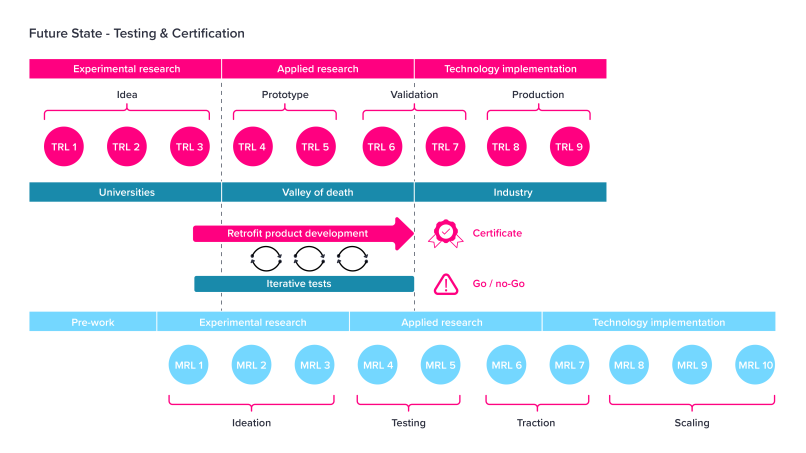
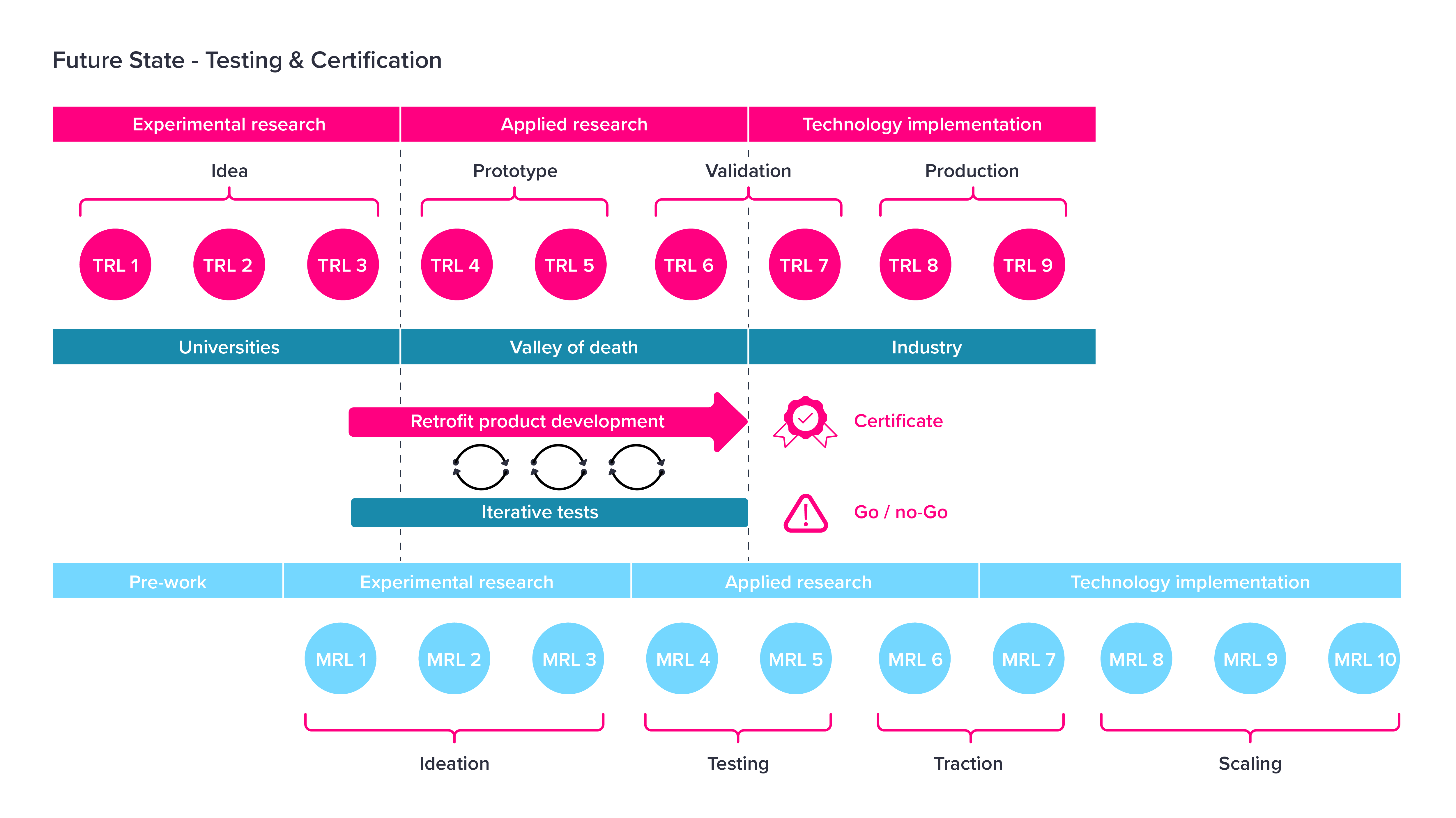
- The ability to conduct rapid iteration in testing, adopting a ‘fail fast’ approach. This would enable quicker lessons-learned, expediate product development, and quicker progress through TRL/MRL levels towards volume production.
- Access for manufacturers to test centres: this would support an iterative design process, enabling more informed product development and more feedback from physical testing before full certification tests.
- Access to finance: potential provision of public funding for iterative testing, before private capital is invested into bringing the product to market.
- Potentially in the form of grants.
- Unlocking private finance at the optimal stage in the product development process.
- Pathway for investors to contribute private finance, with expectation that the product will reach the market and deliver return on investment.
- A global understanding for retrofit: this would ease interaction between stakeholders; such as manufacturers, building control, and tenants; such that all can work together towards an integrated retrofit industry. This rulebook and subsequent updates seeks to address the required common understanding.
- Please see our chapter on an integrated approach to retrofit
Getting from here to there
Questions
- How does the industry encourage innovation in reaching retrofit at scale whilst complying with industry standards?
- PAS, Trustmark + expediated testing and certification process?
- How do we support product developers, without compromising independent certification?
- What is going to make the industry change? Carrot or Stick? (in context of building control)
- How will industry certify at system level i.e. whole house retrofit vs product level?
- Would industry benefit from a design / test sandpit where innovators can test new solutions and go through an iterative fire test process?
Enablers
- New test centres providing iterative tests for manufacturers and product developers. These need to be independent from certification bodies.
- Access to grant funding
- Access to private finance
- Support and guidance to help guide new entrants through the product development process.


“We need to ensure there is a global understanding for retrofit and the broad range of stakeholders involved. From a testing and certification perspective, the industry must set out the expectations from the start to ensure stakeholders such as manufacturers, building control and tenants are all on the same page, moving the industry towards integrated retrofit.”