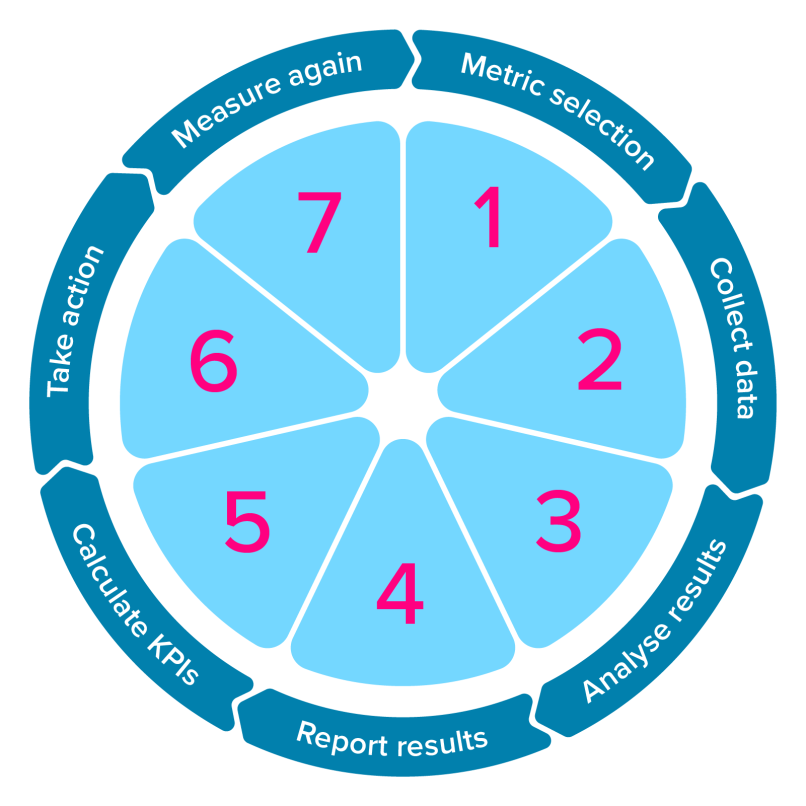
Current state pains and barriers
Pains
Barriers
Current state
Construction organisations that succeed in using Key Performance Indicators (KPIs) are those that rapidly go through the ‘awakening’ and ‘disillusionment’ phases and progress to making measurement a useful tool.
- Many organisations rush from measuring too little to trying to measure too much.
- Overloading dashboards with 20+ KPIs dilutes focus on KPIs that contribute to project success.
- There should be a manageable amount to avoid the measurement process becoming too time-consuming process.
- Projects often only measure KPIs at the end of the project, rather than throughout and making use of live metrics. This limits the ability to act during the project to improve performance.
Metrics have a complex interlocked relationship with each other. It’s impossible to determine the status of a project from a single metric or KPI.
- It’s commonplace for metrics to be viewed in isolation – rather than collectively – when assessing operation, which fails to ‘paint the full picture’ of how a retrofit project might be performing. It’s crucial that the alignment and relationships between different metrics are understood.
A common mistake is focusing on outputs rather than outcomes, tracking deliverables instead of the actual value delivered. A project measures the number of insulated walls instead of the resulting energy savings or efficiency gains.
- Companies often focus on KPIs that “look good” but don’t drive decisions – rather than those that drive improvements.
- Every KPI should answer: “how does this measure contribute to project success and improvement?”.
- Too many KPIs are ‘tick-box’ exercises to ensure minimum standards are met.
- Many companies collect a significant volume of information, without any plan on what the information will be used for.
- It is time and cost-consuming to collect data, and if this data is not used, it risks creating frustration among the people that collect the information.
Frequently the wrong metrics are selected, leading to teams optimising for “what’s measured”, not “what matters”. The metrics may appear positive, but the reality is misrepresented.
- It should be considered when – or if – KPIs should be implemented, as choosing to focus on certain measurements can lead to unintentional outcomes.
- Example: a contractor focuses on reducing installation time, but this drives compromise on quality, resulting in higher maintenance and repair costs.
- Flawed metrics may be selected based on “who’s doing the asking”.
- Selecting commonly used metrics is easy but may be inappropriate.
- Metrics may be selected based on the ease and speed with which they can be measured – a “route of least resistance” – which does not necessarily drive optimal choices.
There is an absence of a standardised KPI framework across retrofit projects, which has led to inconsistent performance measurement and benchmarking.
- The construction sector had the largest number of SMEs of all sectors in the UK in 2024. Individual SMEs are likely to have their own methodology for measuring their performance.
- Measurement can be too resource-consuming for SMEs.
- Supply chain uses different methodologies to calculate different metrics.
- Embodied and operational carbon have varying definitions across industry – some organisations may seek to misrepresent sustainability metrics.
Many statistics may be underreported, such as defects and health and safety.
- Construction sector culture creates an environment whereby employees may be concerned about blame and disciplinary action if they report issues.
- Similarly, there is a pressure to meet targets especially when targets are linked to bonuses, reputation or promotions. This creates an incentive to “look good” rather than being accurate – discouraging transparency in reporting these issues.
- Complex reporting processes can be unclear and time-consuming, which may discourage accurate and timely reporting of metrics.
- Feedback loops – to observe the results of actions taken and to motivate future reports – are often lacking.
- Paints a false narrative of project health, which can have serious consequences for decision-making and risk management. Stakeholders may arrive at false conclusions.
- Calculating true and accurate metrics, such as cost, are a significant challenge for a range of reasons:
- Dynamic and evolving budget forecasts, in combination with an inherent time lag in reporting.
- Influence of indirect and hidden costs, such as unforeseen overheads.
- If KPIs are not adopted and understood wholeheartedly, data collection and measurement quality tends to suffer.
Construction projects regularly utilise inherited KPIs from previous schemes – which may not be relevant to a new project – rather than being systematically defined and tailored to specific objectives and requirements.
- Complacency around KPIs, or allowing them to become outdated, reduces potential impact towards driving improvement.
In the construction industry, some KPIs are mandated by regulatory bodies, clients, or internal governance frameworks. While important, these KPIs often fall short of capturing the true performance or quality of work.
- KPIs are often reported by project controls or commercial teams, rather than those who are delivering on-site. This can create a significant disconnect between what’s being reported and what’s happening.
The majority of stakeholders in the retrofit sector have a diverse range of priorities for metrics, which can often be in conflict with each other. These may vary even within stakeholder groups – it’s difficult to cater for everyone’s needs.
Future state
Construction companies shall measure performance, increasing the ability to control and improve performance.
- Measurement can be used to focus on important aspects critical to the success of a retrofit.
- Measurements shall focus on performance – rather than the results of the KPIs – to avoid manipulation with the sole purpose of making data appear to be good.
Use value definition and measurements derived from the value toolkit to help companies determine what’s important to them.
- This enables companies to define what success looks like, enabling measurement of successful outcomes and acceptable performance ranges.
Application of the 80/20 rule (Pareto Principle) – i.e. identifying the 20% of metrics that can deliver 80% of useful insight or impact.
- This helps streamline performance measurement, focusing on what truly delivers the greatest impact.
- Reduces time and cost spent on collecting and analysing low-value data.
- Resource can be allocated to monitoring and addressing critical metrics.
- Simplifies reporting and communication of metrics to stakeholders.
- Easier to scale, as impactful metrics are likely to be cross-applicable across multiple projects.
Develop a national retrofit performance framework, using a selection of consistent KPIs to measure product, installation, and project performance.
- Standardised measurements create a clearer view of how a retrofit is performing, and the actions that should be taken to maintain or improve performance.
- This enables comparison between projects to facilitate solution sharing and the development of more efficient and effective practices in future.
- KPIs are interoperable across different platforms and stakeholders to avoid siloed data.
- Feedback loop frameworks are implemented to improve service quality.
Establish national databases for retrofit data, enabling stakeholders to better understand retrofit performance, in order to determine benchmarks and facilitate learning.
- Encouragement of data sharing to help compare performance across projects and teams.
- Use historical data to set realistic targets.
Getting from here to there
Questions
- How do we increase accessibility to performance monitoring data – to promote use of in-use metrics, rather than modelled metrics?
Enablers
- PAS framework to encourage compliance by outlining key metrics to achieving retrofit success.
- Align KPIs with funding requirements.
- Greater accessibility to monitoring tools to improve quality and volume of data available.
- Allows for real-time KPI monitoring.
- In-use performance reporting as a condition for public funded retrofit projects.
Key insights
- The diagrams below have been developed to offer high-level examples of KPIs to be implemented across manufacture, installation, dwelling retrofit, and project performance of retrofit.
- There is a mix of industry standard metrics and specific KPIs that may be considered for a Transform–ER project, based on core values and ambitions.
Guidelines
- KPIs should not be fully standardised for each category. It is expected that they shall all have their own specific requirements they wish to achieve. Project-to-project, and product-to-product, certain metrics may not be relevant or considered a priority.
Rules
- Specific KPIs to measure performance, installation and projects delivery must be agreed between delivery and client stakeholders. Quality, Productivity, Time and Sustainability are outlined as options. Please see Table 1 below for a long list of options.