

Current state pains and barriers
Pains
Barriers
Overview
Current retrofit methodology and technologies employed will not meet the required retrofitting rate in the UK. Developing new innovative products would help decarbonise the UK’s housing stock at rates necessary to meet Net Zero 2050 ambitions.
This chapter was written with input from Transform-ER partners KIN and Ultrapanel.
Current state
- The UK retrofit industry is a difficult market for new entrants.
- Established, ‘less risky’ products are prioritised
- High up-front investment costs
- Funding gaps throughout the product development process
- Not enough scalable, successful examples of retrofit products.
- Manufacturers need commitments from Local Authorities to ensure that a pipeline and demand exists. This helps subsidise upfront costs and provide certainty to invest in R&D.
- Without guarantee of re-use across multiple contracts, Return of Investment (ROI) is not justifiable for Small and Medium-sized Enterprises (SMEs).
- Cost and ease of installation are two of the key criteria considered when procuring retrofit solutions and engaging suppliers.
- New products usually entail greater cost. Additional cost can be attributed to:
- Risk and uncertainty in the product’s performance.
- Covering R&D costs.
- Low initial production volume.
- New products usually entail greater cost. Additional cost can be attributed to:
- Design teams often rely on bespoke, ad-hoc detailing that increases risk and cost variability.
- Installers are unfamiliar with new products, hence less efficient during installation. Installers will require training, which drives up cost.
- Successful retrofit innovations are typically single independent components that save time or help resolve interfaces, e.g. solar mounting brackets, bespoke flashings, proprietary independent components. System level approaches would be more valuable at solving the current problems.
- The bespoke nature of retrofit, and variability in building condition have stifled the widespread adoption of offsite manufacturing practices for products that could be used to: reduce cost, increase sustainability, and improve installation efficiency.
- Manufacturers often rush products to market, which can lead to poor performance (with unintended consequences) and increased project costs because of delays and remediation actions.
- There is limited accessibility to testing infrastructure for SMEs to de-risk, improve and measure their product’s performance.
- Hard for businesses to gain indication of product performance to influence design decisions.
- Expensive and risky to go through testing and certification routes, with no guarantee of passing.
- Once products are close to market, the manufacturers need to navigate an unclear testing and certification landscape.
- Regulations are written for current products, not solutions which look to innovate and solve issues in different ways.
- The UK retrofit industry is characterised by a fragmented supply chain with limited domestic manufacturing capability, this continues to slow down retrofit delivery and product development. Multiple tiers of contractors and sub-contractors leads to a risk-averse culture which translates through the supply chain, driving up the cost of products. Deployment is costlier than it needs to be.
- Poor collaboration between the supply chain makes the industry inaccessible to businesses.
- The industry comprises many SMEs who often struggle with resources and capacity.
- Lack of commercial incentive for manufacturers and designers to share innovations due to competitive pressures.
- Lack of established formal feedback loops between tenants and product manufacturers regarding the performance of Energy Efficiency Measure (EEM) products post-install.
- Manufacturers are unaware if their products are operating at their specified performance in the ‘real world’.
- Product developers are missing valuable consumer feedback that would ordinarily drive product improvement.
- Lack of collaboration between architects, engineers, contractors and suppliers to drive product optimisation.
- Local Authorities view monitoring data as a luxury.
- Monitoring technology increases retrofit cost – priority to drive cost down.
- Traditional construction is unable to keep pace with and adapt to fast-changing technology of the world. The aging workforces’ attitude towards change is ‘if it isn’t broke, don’t fix it’. This creates a reluctance to invest into R&D and innovate with new products.
Pains
- Retrofits, even on identical dwelling archetypes, require tailored solutions. Client driven bespoke requirements and unpredictable dwelling conditions prevent design standardisation.
- Lack of standardisation leads to higher costs, lower quality and restricted scalability of products.
- Uncertainty around the retrofit pipeline creates issues in developing products and attracting and retaining talent.
- Difficulty in justifying R&D into product innovation, without a guaranteed pipeline of future orders.
- Day-to-day, site installer personnel may vary on retrofit projects when working with a Tier One contractor – leading to unintended inefficiencies. New installers constantly need onsite training. This results in a likelihood that products are installed incorrectly due inexperienced labour, which can negatively impact performance of Energy Efficiency Measures (EEM).
Barriers
- Research and Development (R&D) involves significant upfront investment in time and resources – something smaller enterprises struggle with. Funding cycles are volatile, making it difficult for businesses to access finance to fund and realise product development roadmaps.
- Local Authorities have under-resourced building control departments – approving these innovative products is time consuming. Building control do not have the capacity to do so at scale.
- Innovation is at a disadvantage if the product is not certified. Landlords favour proven, established products and this is a requirement of grant funding in most cases.
- SMEs often do not have the resources to gain BBA certification, which is a route to expediating building control sign off.
Future state
- Promotion of long-term relationships or alliances based on mutual interest, allowing for continuous incremental product improvement.
- Formal feedback loops are established between stakeholders.
- Retrofit learnings are not lost project-to-project but built upon to achieve continuous improvement.
- Open-source Building Energy Modelling (BEM) software lowers barriers to new market entrants. This promotes a culture of knowledge sharing that will enhance collaboration and breed innovation.
- Creation of interoperability standards ensures products from different vendors are compatible.
- Simplified testing and validation.
- Easier integration between products.
- Increased cost efficiency from reduction in development cost.
- Greater vendor and component flexibility for retrofit designers.
- Retrofit products can be scaled more easily.
- Accessible regulatory fail-fast sandboxes and test houses create faster and more economical routes for certification and testing. This allows for faster iteration and de-risk innovation, accelerating time to market.
- Wide-spread adoption of a Manufacturing-Led approach for retrofitting would transform the industry into being more efficient and sustainable, and drive industry to develop solutions with higher levels of quality.
- Breaking down traditional construction silos and enhancing cross-industry collaboration, feedback loops and knowledge sharing platforms are essential in accelerating product iterations for continuous improvement to improve product quality.
- Higher industry R&D expenditure drives innovation to integrate advanced technologies into retrofitting solutions.
- The construction sector ranks near the bottom of the table for R&D spend which is inhibiting innovation.
Getting from here to there
Enablers
- Long-term alliancing models to promote collaboration.
- Fail-fast pilot programmes or sandboxes to showcase capability and accelerate R&D.
Key insights
- Standardisation and competitor collaboration for product development are both critical for scaling retrofit.
Guidelines
- Given the current state of the fragmented market, inconsistent pipelines and funding, innovations have had to payback within project lifecycles which are very short and thus have only yielded simple low-investment innovations, such as switching out materials, or tools/fixings to reduce immediate labour costs. Therefore product developers should be encouraged to collaborate on products and retrofit standard details, while being clear on foreground and background IP.

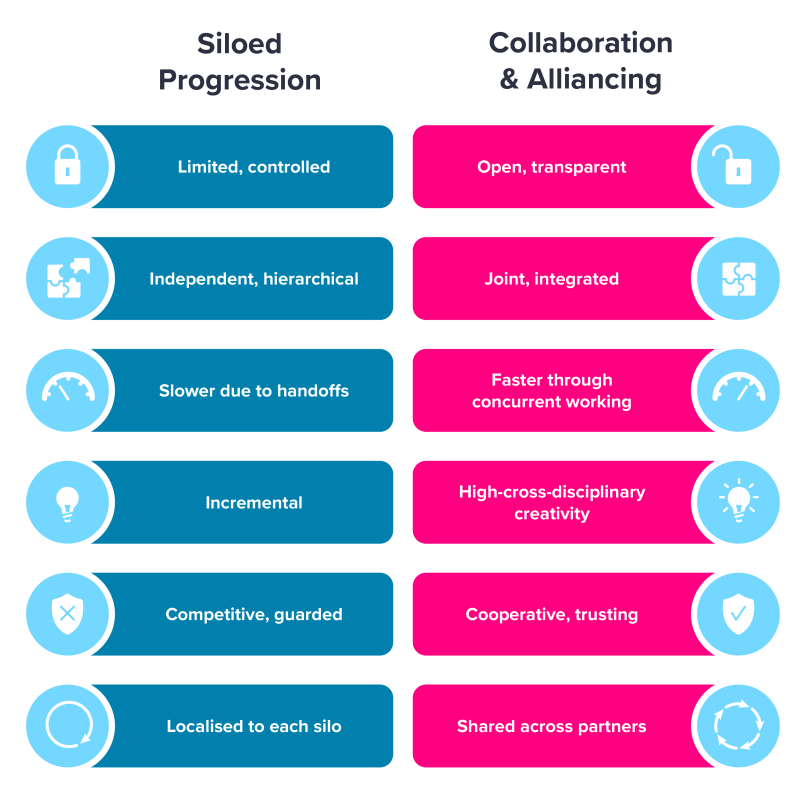
“The construction industry often has a lack of connection and collaboration between constructors and designers, and often information travels in only one direction – from designers to constructors with lessons learnt about what did or didn’t work not effectively shared back to designers to enable continuous improvement and innovation. Many companies even struggle to share information effectively within their own organisations, between teams and one project and the next.”