
Current state pains and barriers
Pains
Barriers
Overview
Capturing high quality data, with sufficient detail, for retrofit projects is essential to enable economies of scale within delivery; because if more detailed data sets are available for properties, the subsequent phases of project development and delivery can be more consistent and streamlined.
Transform-ER partners Planarific and Ambue have led research into this as part of the project.
Current state
Portfolio Surveying for retrofits currently has the following challenges:
Data gathering is currently a very manual process.
- Often this involves inspecting every property individually, which can be very time consuming.
- The data collection process relies heavily on occupier co-operation, for example granting access to garden areas.
Time and cost of completing surveys
- High dropout rate of potential retrofits based upon information discovered at stages throughout the survey process.
- Tenants can also suffer from survey fatigue, adding to the dropout rate.
Portfolio surveys completed using modern or novel technology such as drones can often meet resistance and opposition.
- Completing surveys requires an upfront monetary investment from landlords.
- Drone scanning can be viewed as intrusive or an invasion of privacy.
- The benefits of using drones for surveys are yet to be proven with substantial evidence, such as cost-effectiveness.
Current procurement models are prohibitive to a novel approach to gather large quantities of data prior to retrofit project kick-off.
- Costs for surveys can often not be covered upfront.
- Resource constraints mean additional engagement with survey companies is not possible from the landlord, usually all aspects of retrofit are covered by a contracted surveyor.
- All social housing landlords have unique and specific rules to follow, which are not clear or visible until the landlord is engaged with the process.
Drone based data gathering solutions present unique challenges compared with traditional methods of portfolio analysis.
- Additional security may need to be provided to ensure drone assets and ancillary equipment is not stolen.
- Permits may be required to fly drones in certain areas, such as near to airports or in conservation regions.
- Tree coverage in built-up areas can prevent capture of the data required to accurately assess a property.
- Data processing of large volumes of information may become costly, depending on the level of fidelity of data required, downstream in the retrofit process.
- Considering legal compliance, processing of sensitive data and cybersecurity to ensure data is stored safely.
Future state
The following has been identified for the future state of portfolio surveying:
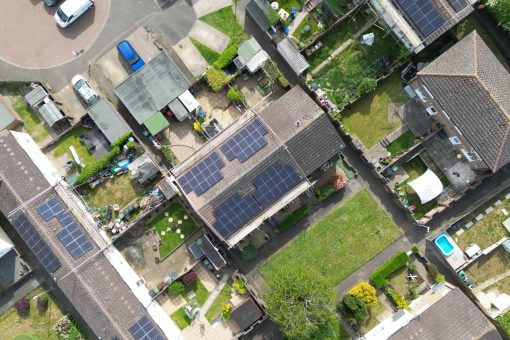
Technology led portfolio surveying methods such as drone scanning are employed, expediating the surveying process, and enabling greater volumes of retrofits to be fed into the pipeline.
- Roof drone surveys can remove the need for manual inspections and reduce cost of inspections by 75%.
- Drone surveying with a team of two people can provide a method capable of gathering the required external property data for 500-1000 properties per day.
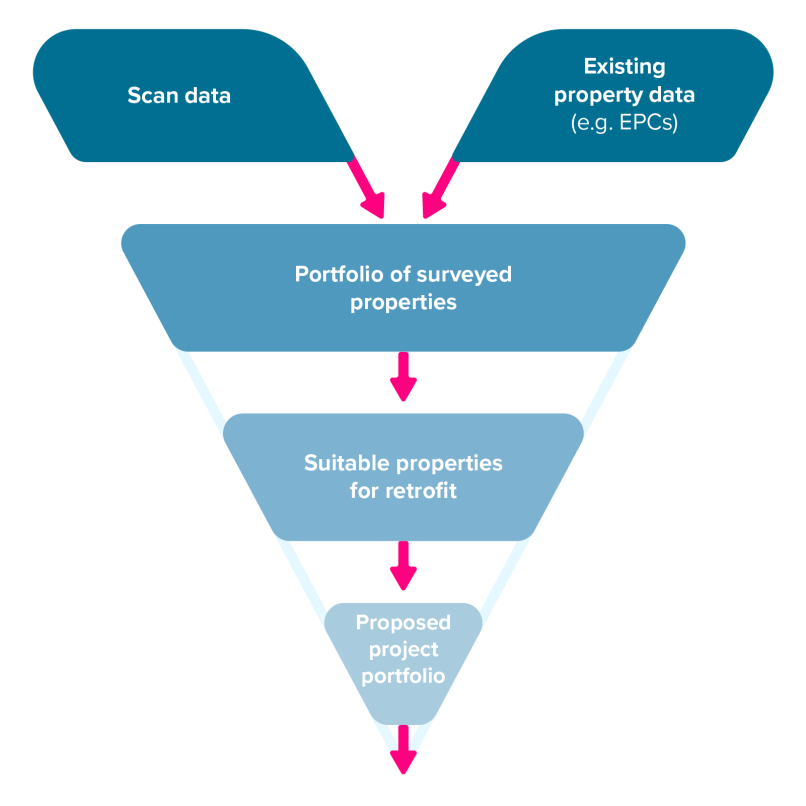
Data collected from drone scanning is paired with existing building data, such as EPCs and plan data, to create a holistic data set for an individual dwelling.
- This allows professionals downstream in the retrofit process as much visibility as possible, as early as possible.
Property surveying is completed upfront and independently of specific projects, to create a large and expansive database of dwelling information, enabling:
- Elimination of repeated surveying
- More accurate and repeatable portfolio selection
- Greater clarity of pipeline demand and requirements
- Streamlining of the design and delivery tasks
- Better information for residents about their homes and likely costs for retrofitting.
Further to the above point on survey databases, a national retrofit survey database could be developed. In this case, GDPR and cybersecurity concerns would need to be addressed. In a recent report from the the Information Commissioner’s Office and Kestrix Ltd, key points on GDPR are as follows:
- Building information data, geometry, geographical information, with the appropriate de-sensitisation process, will not be personal and no longer fall under GDPR.
- Original data such as photos of buildings or thermal imagery (in Kestrix’s case) may pose certain privacy concerns, such as inferring the demographics of the residents in a building, or usage patterns.
- Identifying a lawful basis for processing (typically legitimate interests for commercial surveying activities) and conduct Data Protection Impact Assessment (DPIA).
Portfolio scan data feeds seamlessly into the later stages of the retrofit process, from the DEMAND phase to the DEVELOP and DEPLOY phases.
- This provides designers, architects, and product manufacturers the information they need – and in the required formats – to deliver consistent retrofits at scale.
The use of more detailed portfolio surveys better informs the business case development for retrofit projects, leading to more predictable and standardised costs.
Getting from here to there
Questions
- Can landlords adjust procurement strategies to better facilitate data collection, or can Transform-ER provide that pathway?
- Can upfront funding be provided to gather necessary data prior to project commencement?
Enablers
- Access to funding in the DEMAND phase, prior to project initiation.
- Examplar case studies, whereby new/innovative methods of portfolio surveying have been utilised, and the benefits of using such techniques have been documented and quantified.
- Cybersecure national retrofit survey database would avoid repetition of surveys and reduce costs.
- Increased data enables better engagement tools for residents as more information and insight can be provided to them.
Key insights
- Breaking down silos between social and privately owned properties will enable economies of scale and rate of retrofit to expand at a faster pace.
Guidelines
- Adequate costing and budget provided in the DEMAND phase, to complete portfolio surveys, facilitating more accurate, detailed data for the DEVELOP and DEPLOY phases.
“Portfolio surveying needs to be the expansive entry point to the retrofit funnel, collecting data on mass for down selection of retrofit projects, enabling retrofit at scale”