Current state pains and barriers
Pains
Barriers
Current state
Energy Efficiency Measures (EEMs) are mostly installed independently of each other, in line with the supplier’s retrofit system design.
- The output of solution matching measures together can lead to it being greater than the sum of its individual parts.
- When independent measures are not considered as part of a whole building retrofit, there are often unintended consequences or rework required at a later stage to accommodate measures.
- A retrofit would typically have a retrofit designer involved in putting together various suppliers’ products and working out the junctions between them.
- The process is time consuming and design costs can quickly escalate when trying to achieve a particular performance target.
- Often designs change as a project develops leading to further costs of reworking junctions between measures and ensuring function. This can create a barrier to delivering retrofit as projects don’t budget for iterative designs leading to design compromises and sticking to initial proposals which may not be best choice.
Complex retrofit projects often suffer from fragmented design and delivery, where architects and engineers hand over designs to contractors without early collaboration, leading to costly changes and implementation issues.
- Current contracting models don’t incentivise collaboration which can prevent against design changes at later stages by spotting them early on.
There is no systematic approach to retrofit and contracting. It would be a challenge to achieve retrofit at scale using current models and frameworks.
- Retrofit is generally considered to be high risk due to the large number of unknowns involved. Currently, contracts struggle to account for this. This can result in project delays, as well as cost escalations; both of which present barriers to delivery.
- Retrofits usually require a bespoke approach regarding design solutions, contracting, and financing.
- Retrofit processes which could be repeatable and standardised often must start from scratch, which increases project cost and time.
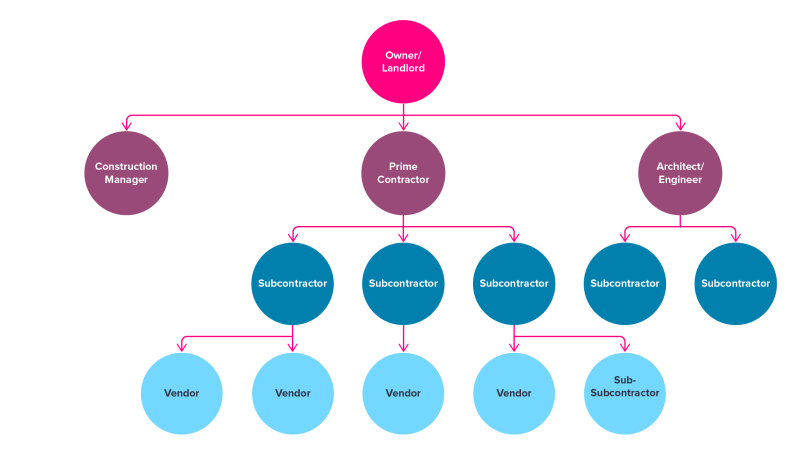
From a contractor perspective, retrofit in the UK is highly fragmented. Contractors work independently in isolation from each other rather than a team which can pre-emptively tackle interoperability from the outside. (See Figure 1)
- Projects require several contractors to install different EMMs.
- Involvement of multiple contractors is inherently inefficient. Focusing single contractors on single EEM’s limits the potential of innovation due to siloing.
- It is difficult to complete a whole house retrofit approach in a single iteration owing to the fragmented nature of supply chain, installers, and other specialists.
- Limited resource sharing – i.e. tools, equipment, knowledge, and services – can also lead to increased costs.
- Risk is passed down the “contract chain”.
- Cascading risk leads to a compounding of costs throughout the built environment sector in the UK.
- There are a lot more risks and unknowns in retrofit compared to new-build construction as every building is unique.
SMEs can often struggle with current contracting structures, payment flows and timings. These need to be considered for commercial risk management for SMEs.
- The construction and retrofit sectors rely heavily on SMEs, accounting for the largest number of SMEs of all sectors in the UK in 2024.
- Difficulty in SMEs sub-contracting due to the capital flow down through the supply chain.
- Each element of work is often contracted separately, via a managing contractor.
The sector struggles with a lack of transparency and accountability on deliverables between contractors. Commercial agreements can suffer from a blame culture, which restricts and damages the potential for collaboration.
- Contracts are often overly complex and lack sufficient oversight of the project.
- This allows for profit-driven motives to take precedence over public interest.
- Although retrofit contracts may explicitly mandate collaboration by incorporating contractual promises, such intentions often falter in practice without robust commercial frameworks and incentives to reinforce them.
- This can result in a reversion back to conventional siloed behaviours.
Grant funding plays an integral part in being able to implement retrofit; however, funding timelines can exacerbate supply chain issues, and encourage short-term contracting, which can have detrimental effects.
- Grant deadlines distort the pricing of retrofits as there is a high demand for competent contractors at the same time.
- This leads to poor value for money as supply is limited.
- Most social housing schemes utilise some form of public funding mixed with private funding.
All firms from main contractor down ensure design risks are passed onto sub-contract activities.
- This explains why construction costs in the UK are so high, as the cost of addressing risk is compounded.
The construction and retrofit sector is regarded as one of the most conflict and dispute-ridden industries, which has resulted in it being one of the most claim orientated sectors.
- More than 30,000 UK homes have had “botched” insulation fitted under government scheme ECO4 putting them at risk of damp and mould.
- There are few established conflict resolution frameworks that are actively implemented into projects and industry to overcome disputes. Disputes result in delays and cost overruns.
- Joint Contract Tribunal (JCT) contracts have been developed to set out terms for procurement, payment, variations, and dispute resolution. This aims to simplify and reduce ambiguity in contractual relationships for UK construction.
There is no Private Finance Initiative (PFI) model whereby private capital funds public infrastructure. New contracts are needed to allow private finance involvement due to lack of retrofit financial resource and to improve their ability to invest.
- Government borrowing constraints and the UK’s financial position mean investment into the existing building stock is a challenge.
- Landlords will struggle to finance new builds and retrofit whilst maintaining a credit standard.
Typically, there is a high cost in contractors bidding to join frameworks and then landlords will procure them under design and build contracts.
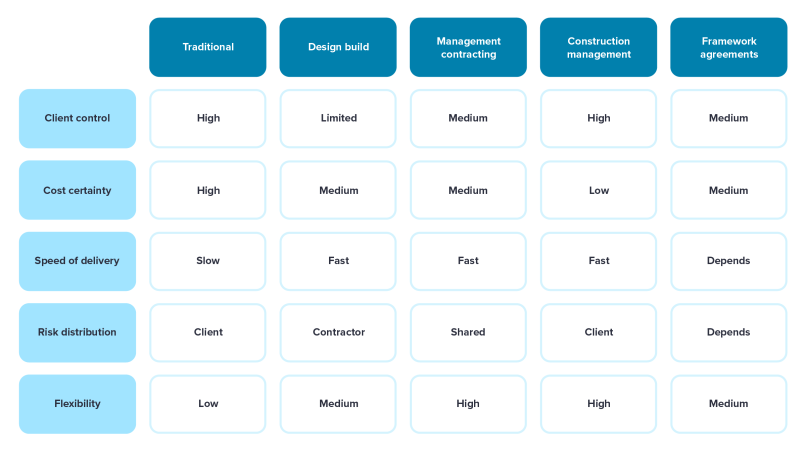
There are five main procurement routes in the UK. These different procurement types have different levels of control, cost, risk, speed, and flexibility. (See Figure 2)
The challenges outlined above stifle innovation, as well as product and project development. The fragmented nature of stakeholders involved in retrofits make it difficult to define clear, standardised retrofits, as a combined package of all the elements – e.g. the pipeline of demand matched with retrofit solutions, contracts, finance, and procurement.
- The current market lacks a scalable, standardised retrofit package that landlords can straightforwardly procure.
- Unpackaged retrofit requires bespoke design and procurement for each property which can often lead to longer project timelines and higher costs due to the fragmented nature of supply chains and inconsistent installation practices.
Future state
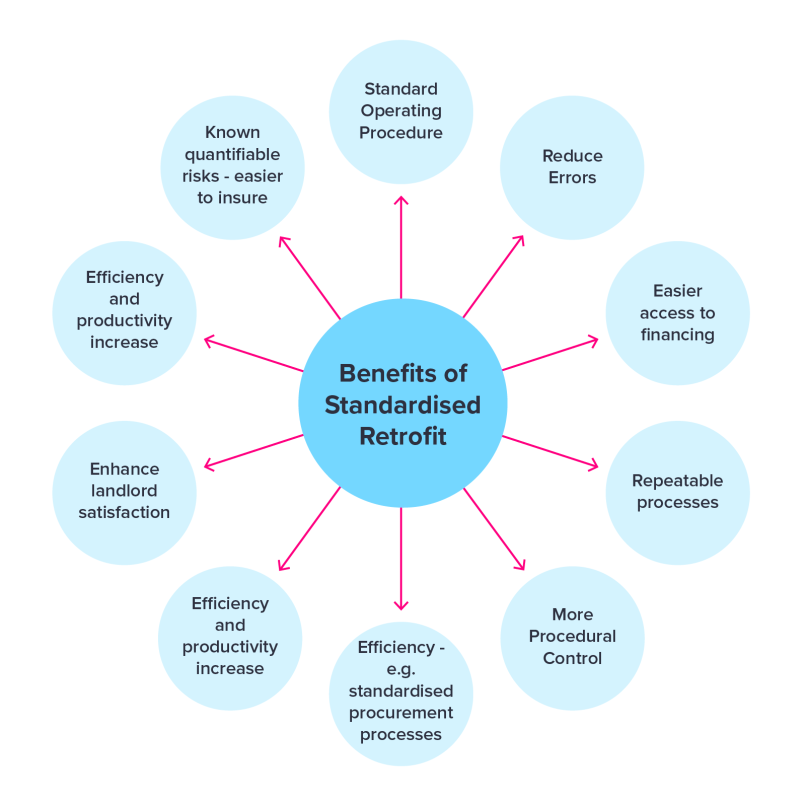
A packaged retrofit is characterised by the combination of kits-of-parts and associated structured information, stakeholder roles and responsibilities, an outline business case detailing known outcomes, and contracts and agreements. (See Figure 3)
This approach mitigates fragmented processes, reduces risk, and enables predictable performance outcomes. By creating repeatable, financeable and insurable packages, landlords gain procedural control, can accelerate deployment across portfolios, and unlock private investment confidence.
Please see the Transform-ER kit-of-parts and interoperability chapter for more information.
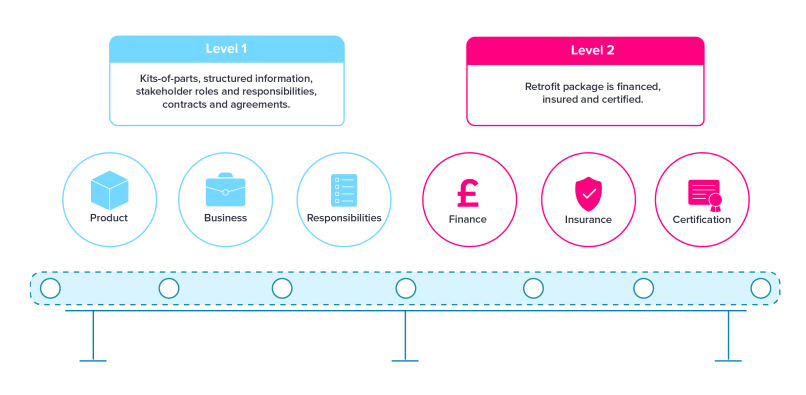
Initially, Transform-ER suggests two levels of a packaged retrofit:
Level 1 – as above with technical and organisational information.
Level 2 – retrofit package is financed, insured, and certified. Contractual and procurement processes are standardised. (See Figure 4).
The following seven elements have been identified to form part of a standardised and repeatable retrofit package:
1. Retrofit kits-of-parts that are standardised and enable mass customisation, with value propositions that directly contribute to performance outcomes.
- Implementation of contractual KPIs to measure progress and performance of suppliers in delivery phase of a project.
- Helps benchmark a dwellings performance against known data.
- Drive both a focus on outcomes and continuous improvement.
2. Solution matching of standardised kits-of-parts that can be configured to match different portfolios of projects.
- Matched to dwelling archetypes.
- Matched to customer requirements.
3. Simplified procurement routes which enable landlords to select and implement programmes of work easily, cost effectively, and without interruptions created by stop-start procurement cycles.
- Procurement processes should be proportional in terms of duration and effort to the size and complexity of the contract opportunity – so not to create barriers to entry for SMEs.
4. Effective contracting
- Programmes should move to long-term contracting or frameworks.
- Facilitates supply chain to invest and develop improved solutions.
- Increases efficiency of starting projects through reducing or eliminating non-value adding processes such as having to tender each time.
- Long-term contracting fosters a greater culture for collaboration and team building, as contractors can build relationships through working with familiar contractors.
- Opportunities to implement lessons learned from previous projects for continuous improvement, rather than moving onto the next project and risking these lessons being forgotten.
- Guaranteed pipeline of work for businesses having demonstrated good performance.
- Contracts should explicitly promote collaboration; not just in language, but also in structure and incentives.
- Management process to identify companies that are “cultural fits” for projects.
- Clearly define the process and behaviours expected, to reduce the risk of mismanagement.
- Provide clarity on contractual responsibilities and outline how disputes shall be resolved between parties.
- Standardised contract terms can simplify and speed up procurement processes, whilst improving transparency of expectations.
- Best practice is more easily embedded, and suppliers are more likely to experience a consistent application of policies and practices.
- Conflict Avoidance Pledge (CAP) to be adopted with the use of amicable resolution procedures to deal with emerging disputes at an early stage.
- Prevents the escalation of problems to disputes.
- Early intervention helps reduce any costs associated with addressing disputes.
- Transform-ER has selected an alliancing model. Table 1 outlines the known benefits of adoption.
| Benefit | Description |
| Collaboration and trust | Unified contracts, shared objectives, transparent communications |
| Risk and reward sharing | Collective accountability via pain/gain mechanisms |
| Value for money & Cost savings | Prioritised total project outcomes over individual cost-cutting |
| Innovation | Enables creative solutions and early issue resolution |
| Agility | Rapid adaptation to changes in project scope or environment |
| Fewer disputes | Cooperative culture minimises conflicts and claim |
- Table 1: benefits of an alliancing model in the built environment
Find out more on alliance contracting models through these recent articles:
- What Is Alliance Contracting and How It Works?
- Project Alliancing: Building Trust, Saving Money, and Transforming Infrastructure
- Maximizing value through alliance contracts in program management – Blog
5. Finance matching to enable effective mix of private and public finance.
- Reduction in reliance in grant funding to provide better value for money as resource is less competitive.
6. Structured information
As defined in the Construction Innovation Hub Product Platform Rulebook:
- Product information.
- Deployment information.
Additionally:
- Standardised Operating Procedures (SOPs) for manufacturing, assembly and installation processes
- Clearly defined roles and responsibilities.
7. Certification and insurance
- The standardised retrofit package and its kit-of-parts shall have the necessary test certifications.
- The standardised retrofit package shall be insured.
Getting from here to there
Questions
- How can we move to a long-term contract model without inhibiting innovation and blocking new suppliers from joining existing contracts?
- How can we get contractors to commit to cost over long periods of time for a programme?
Enablers
- Appropriate level of risk is distributed across large and small enterprises to prevent overburdening of SMEs that may lack appropriate resilience independently.
- Alliancing provides a shared risk and reward which would be fairer and more balanced.
- Promotes collaboration to work together differently and creates incentivisation for performance.
- KPIs and analytics to monitor performance of projects, to help motivate overperformance from contractors and reward.