

Current state pains and barriers
Pains
Barriers
Current state
The following describes various logistical challenges that have been identified in current retrofit projects / activities.
On-site snags
- Structural changes or elements that have not been identified as part of a housing survey and are discovered as the installers arrive onsite. Examples include removed chimney stacks which can go unnoticed until works start, leading to additional mitigation actions outside of the planned work.
- Service locations (electrical, gas, and water) can interrupt planned works. For example, gas mains cannot be disconnected if the tenant is in debt with their energy provider. Façade panels are structural. As such, if the façade panels at ground level are unable to be installed around existing services, subsequent façade panels for above-ground levels are unable to be properly supported, leading to delays.
- Incorrect scaffolding set up can cause disruption. When installing EWI, scaffolding must be erected with a gap to the façade so that the panels can be passed between the scaffolding and the façade. Many scaffolding companies are not familiar with this.
- Material delivery to site often includes a surplus to accommodate loss and breakage on site. This is not lean.
Stakeholder engagement and communication
- Property boundaries can be obscured by façade finishes like renders, pebble dash etc. This can lead to disputes with neighbours about “who owns what” and “who is responsible for what”.
- Significant time and resource is expended by explaining the specifics of a retrofit project to occupants and other stakeholders. This can take focus and energy away from effective on-site management of the retrofit.
- Party wall agreements are vital to ensure neighbours are aware of works being done and how it might affect them.
Delivery
- Attempts to use Just-In-Time (JIT) delivery, such as scheduling fasteners to arrive precisely when needed, are undermined by uncontrolled processes and missing parts which cause retrofit delays.
Training and scheduling
- Transform-ER partners have experienced a lack of competency in subcontracted labour, requiring last minute training on site during works and rework.
Vehicle requirements
- Cranes are not an absolute necessity as it is often possible to lift materials using hoists mounted to scaffolding. However, this also complicates scaffolding requirements as the structure must be able to withstand and balance the load of all materials being lifted.
There is no universal accreditation for installers across all retrofit measures – despite many consumers preferring it.
- Microgeneration Certification Scheme (MCS) certifies installers of small-scale renewable technologies to ensure their work meets industry standards for quality, safety and consumer protection in government funding scheme projects.
- Installation quality assurance is highly variable, especially for fabric Energy Efficiency Measures (EEMs).
- Poor workmanship often leads to products not achieving their designed performance specification.
- Projects typically prioritise cheap labour which leads to additional remediation costs and corrective actions.
On site assembly is still the primary method of construction used in retrofitting.
- This exacerbates issues surrounding quality control due to the uncontrolled environment, inconsistent workmanship, and reduced ability for inspection and testing on site.
- On site labour and trades may not be experienced in the use of retrofit products, and will require training.
- On site assembly is a more inefficient method and typically has an increased installation time.
- Skilled labour – which is already a diminishing talent pool – is often required to assemble on site rather than taking advantage of automation technologies off-site.
Future state
The future state of site delivery, and installation necessary to achieve retrofit at scale should include the following:
A preliminary survey
- Information pulled from a digital platform and consultation with local authorities.
- Mechanical viability testing such as hazardous material and pull-out testing conducted either by manufacturer or by a trained subcontractor.
- Surveys scheduled efficiently and communicated to landlord and occupant to streamline the process and minimise disruption.
- Service Mapping using technologies such as Ground Penetrating Radar (GPR) and Electromagnetic (EM) surveys to locate legacy infrastructure.
Install management
- Customer liaison App to ensure all stakeholders are aware of the content and timescale for retrofit works.
- Digital record keeping of works to ensure the system can be signed off and warrantied.
Product delivery
- Delivery of goods should be JIT for install, reducing the security risks of storing materials on site.
- Effective delivery planning and palletisation is crucial to efficient (JIT) delivery of products and materials to site. Engagement with packing teams to understand the constraints of packaging and explain the necessity for certain products to be packed together to aid on site sequencing.
- Products should be packed according to the sequence they will be installed, i.e. first installed component is packed at the top of the first pallet delivered to site.
Reverse logistics and circularity
- Material passports could enable tracking of components and materials for reuse or recycling at their end of life.
- Deconstruction planning should take place and align with PAS 2080 and ISO 20887 for circular economy compliance.
- Pre-construction planning should include the use of multi-drop scheduling (using a single vehicle to make multiple deliveries) and backhauling (using the empty return leg of a delivery to remove material from site).
Material delivered to site with each project
The following materials should be provided on site for every project:
- Panel set – all system parts and materials required to complete the project.
- Install guide – guidance on the specific retrofit details and the required installation process for the systems being installed.
- Site Pack – details of the property, precise measurements, locations of where everything needs to be installed, according to the project at hand, as well as Standardised Operating Procedures (SOP) for installation processes.
- Palletisation pack – packed location of each item needed for install.
Getting from here to there
Questions
- How can we improve communication lines between stakeholders? E.g. Customer liaison platform to streamline communication and planning data between stakeholders.
Enablers
- Standardised and interoperable kits-of-parts to reduce variation of install methods and simplify training for installers.
- High precision and detailed property surveys to avoid unforeseen problems at install.
Key insights
- Vehicle selection: avoid articulated trucks in urban areas; prefer rigid lorry mounted cranes (often referred to as Hiabs).
- JIT delivery: requires agile scheduling and coordination with suppliers to avoid on-site congestion and delays.
Guidelines
- Digital retrofit build schedule – app or digital dashboard, with access to all stakeholders including the resident.
- JIT delivery of materials to site to minimise storage needs.
- A dimensional survey to be conducted.
- BIM Integration: supports tolerance checks and panel optimisation.
- Avoid articulated trucks (Artics) for urban deliveries; use rigid Hiabs with crane capability.
Rules
- Every project comes as a kit-of-parts delivered to site, with required instructions e.g. bill of materials, installation guide, site pack (list full documents).
- A minimum level of survey has been conducted prior to on site retrofit.
- A retrofit build schedule must be documented.
- Measures must have standardised on site processes documented.
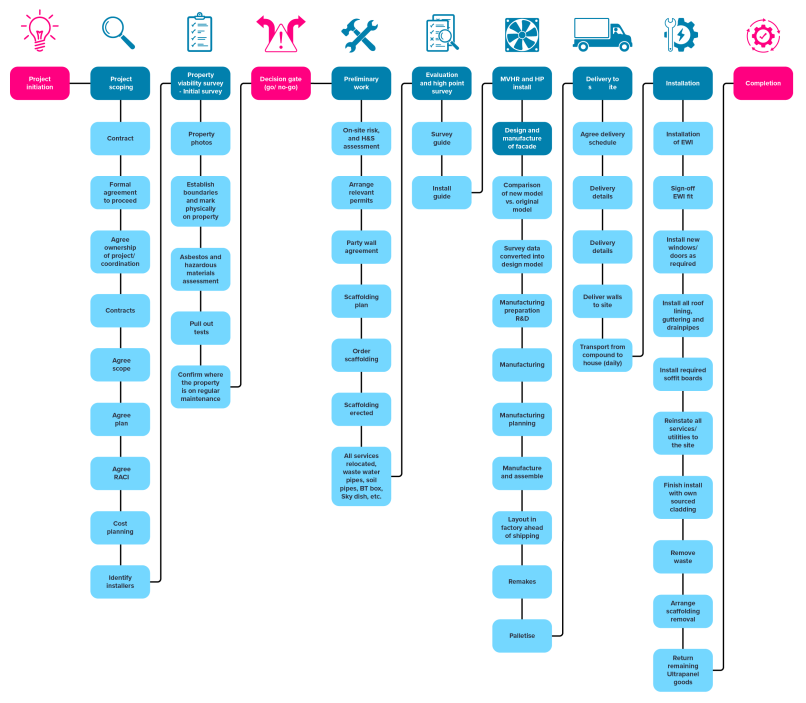
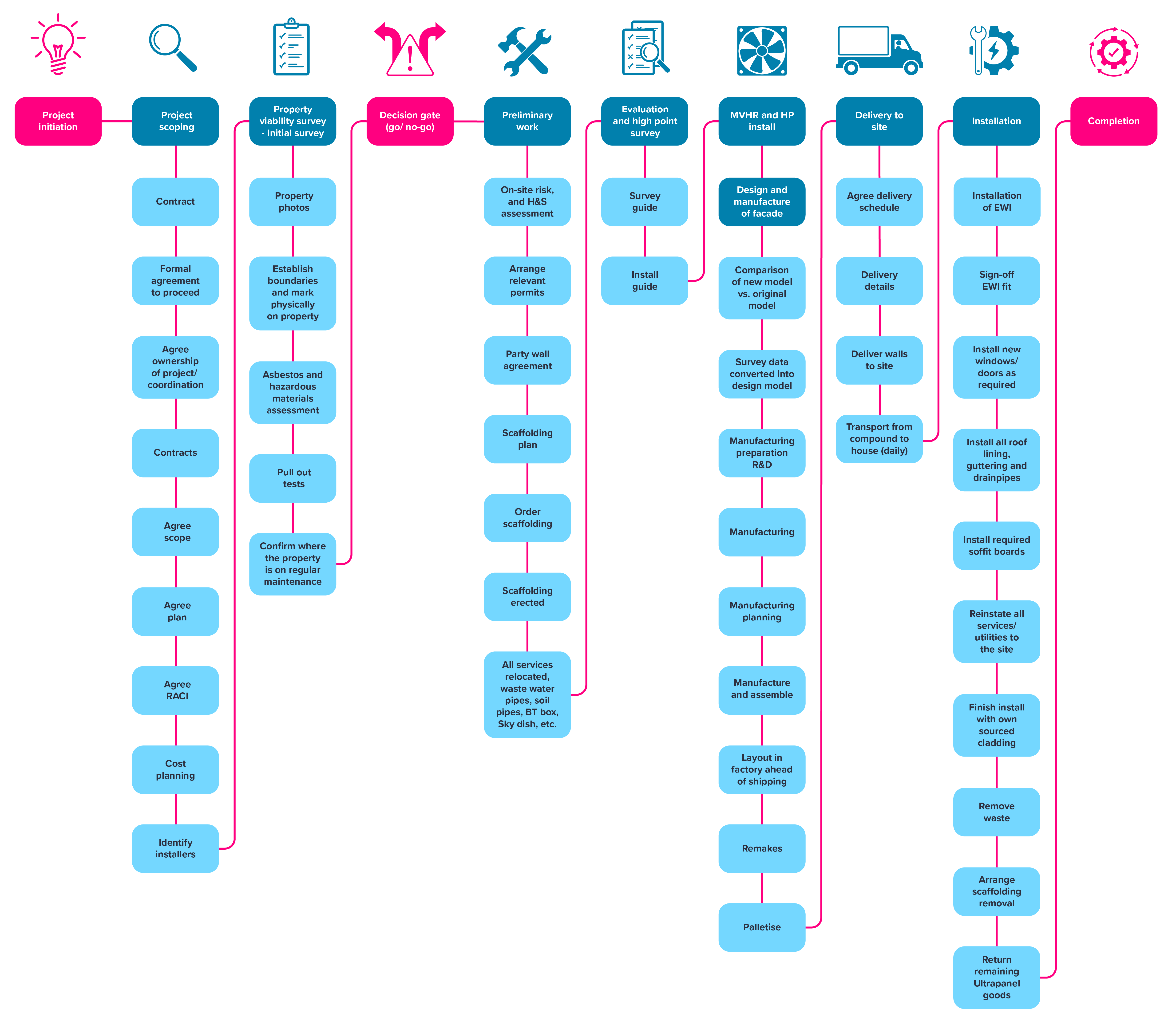
Retrofit work occurs in live environments, often with residents on site. Installation logistics must account for minimising disruption, maintaining access routes, managing noise and dust, and coordinating around occupant routines. Scaffold placement, access equipment, and manual handling methods must all be adapted for retrofitted buildings, which often have uneven surfaces, awkward layouts, or legacy construction quirks. Ensuring good stakeholder communication is key.