

Current state pains and barriers
Pains
Barriers
Definition of a dwelling kit-of-parts
Every product, system, measure or component required to deliver a whole house retrofit for a portfolio of properties.
A dwelling kit-of-parts (KoP) is the highest level of the KoP Hierarchy for one property, consisting of all manufacturer’s kits-of-parts.
(Source: Transform-ER)
For further definitions relevant for this chapter, please see Transform-ER kit-of-parts and interoperability.
Current state
As outlined by BRE in the state of the market report, integrated solutions or whole house retrofits are complex to certify, due to:
- Multiple performance factors
- Overlapping product warranties and certification
- Boundary of product certification
- Overlapping certification offerings and organisations in the market, at product level.
Dwelling system level certification has the following added complications:
- No clear organisations exist that are capable of signing off at dwelling level vs product level. This is a major gap in UK capability highlighting a barrier to reaching retrofit at scale.
- As highlighted by the Connected Places catapult, mass customisation is key to achieving retrofit at scale. This involves using combinations of variable kits-of-parts, at scale.
- How does industry expediate the process of certifying – at the dwelling level – for all the different combinations and iterations of kits-of-parts?
- Certification at dwelling level for a portfolio of properties is critical for unlocking insurance and finance.
As part of the Transform-ER UKRI programme, a certification event was held at MTC Liverpool in September 2025, attended by organisations involved and leading in this area. Positive and productive discussions led to consensus on these key points:
- The current certification landscape is fragmented with inconsistent language and policy, and unclear timeframes and expectations.
- We need to strengthen industry capability and SME support through consistent guidance, signposting and matchmaking to help innovators navigate the certification landscape – like ESC’s Sherpa Service.
- Education for residents and installers needs to be improved through clear guidance to counter misinformation and negative publicity.
Future state
Reaching an ideal future state for system level certification is a significant advancement from the industry current state. Therefore, the following points are speculative, to illustrate what an ideal state could be:
- From the certification event held at MTC Liverpool in September 2025, discussions highlighted that, for the future of certification at a system level:
- We need a national ‘lily pad roadmap’ with a clear pathway from initial safety checks to provisional approval and full certification – with consolidated auditing roles and modular retrofit standards.
- Funding, procurement and insurance need to be aligned with certification to help absorb early risk.
- For reaching retrofit at scale, a clear route for certifying variable combinations of retrofits, comprising of interoperable kits-of-parts for divergent portfolios of projects.
- A certification framework for product developers to follow, outlining which organisations must be involved at specific stages in the process, e.g. BRE for Product Testing.
- This should include a hierarchy of certification and associated organisations.
- Industry agreed criteria for system level certification.
- How do two different energy efficiency measures (EEMs) / retrofit products interact and how do you qualify this from a functional performance perspective, at system and product level?
- See also the Functional requirements checklist.
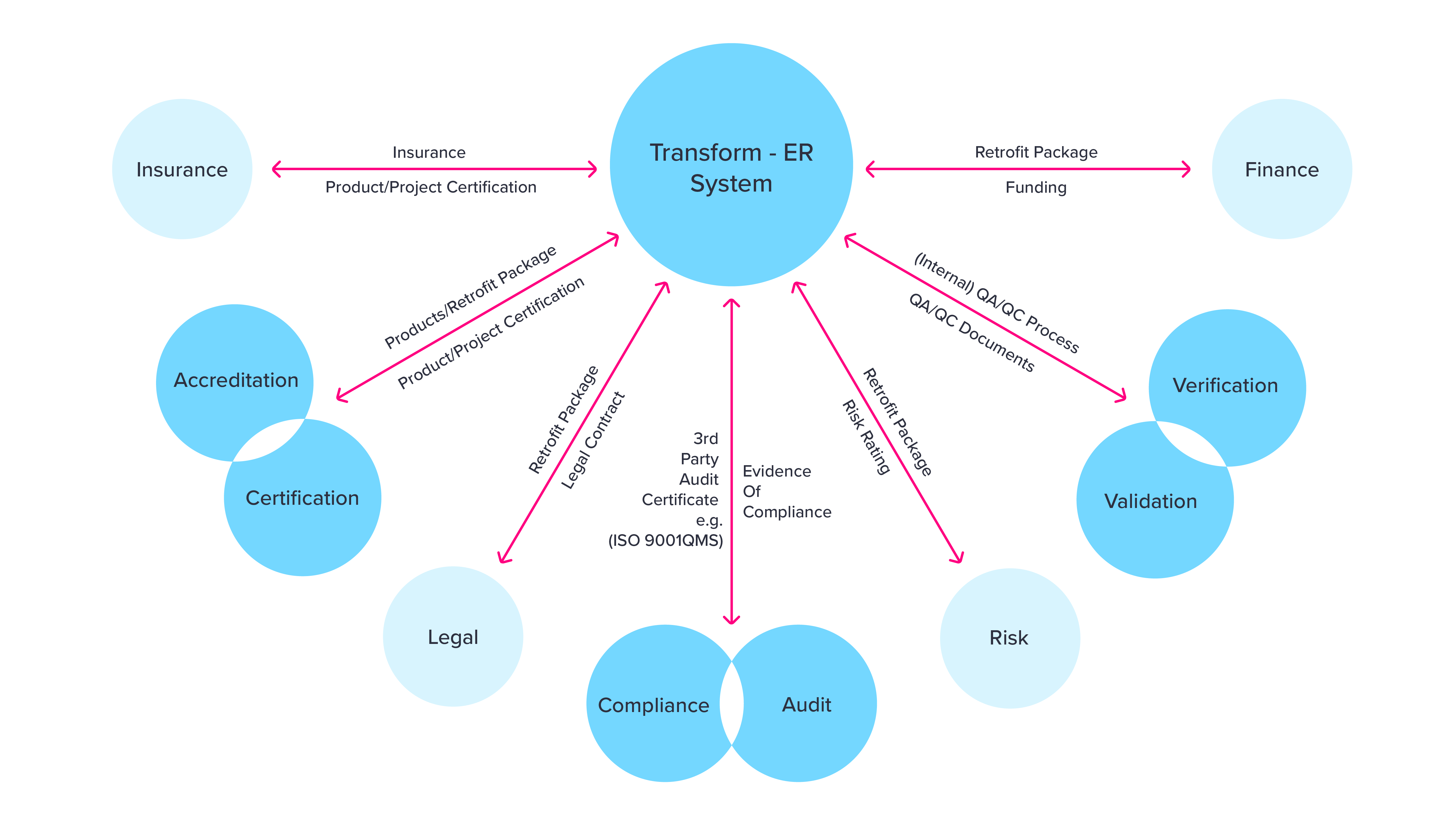
To highlight the complexity of functions and stakeholders on this topic, Figure 1 shows the finance, regulatory and compliance ecosystem required for the dwelling system level certification to function.
Getting from here to there
Questions
- Mass customisation is key to achieving retrofit at scale, this involves combinations of variable kits-of-parts, at scale.
- How does industry expediate the process of certifying at the dwelling level, for all the different combinations and iterations of kits-of-parts?
- How do two different energy efficiency measures (EEMs) / retrofit products interact and how do you qualify this from a functional performance perspective, at system and product level?
Enablers
- Industry route map to reaching system level certification for mass customisation of retrofit at scale and interoperable kits-of-parts.
- We need a national ‘lily pad roadmap’ with a clear pathway from initial safety checks to provisional approval and full certification – with consolidated auditing roles and modular retrofit standards.
- Funding, procurement and insurance need to be aligned with certification to help absorb early risk.

“Adopting a platform approach for retrofit enables the move towards mass customisation and interoperable kits-of-parts”.