

Current state pains and barriers
Pains
- No granularity in national, regional, or portfolio housing data
- Limited accuracy of the information gathered.
- Designers collect information each time they work on a home given poor data and liability sits with them.
- Information is often decentralised and difficult to compile in a coherent manner.
- Current manual inspection techniques are costly and laborious.
- Attrition rates of ~30% per stage in of a retrofit project.
- Designers collect information each time they work on a home given poor data and liability sits with them.
Barriers
- No digital software systems available to centrally store and provide access to property data.
- Inspections are susceptible to human error or a lack of available information.
- Current funding models are project-based, making it difficult to finance portfolio-wide surveys.
- Difficulty in proving long-term cost effectiveness.
- No commonly used data structure means data doesn’t get transferred or stored by the housing owner so is frequently lost at the end of the project.
- Social housing landlords have established processes, new approaches require resource shifts and mindset changes.
- Advanced surveying technologies such as drones encounter operational issues such as locational flight restrictions (e.g. near airports), and weather related flight barriers (e.g. rain).
Overview
Understanding the pipeline of future retrofit projects is key to the effective deployment of Manufacturing-Led retrofit. This section outlines the market requirements of the UK’s current pipeline of potential retrofit projects and how the requirements can be segmented by archetypes.
The Harmonise, Digitise, Rationalise (HDR) Framework (see image below) developed as part of the Construction Innovation Hub and the Construction Playbook aims to improve efficiency, reduce waste, and drive innovation in construction projects by standardising processes, leveraging digital tools, and simplifying demand.
Harmonise
Goal: Align requirements across retrofit projects
How
- Standardise designs components and specifications where possible
- Use common platforms and frameworks to reduce fragmentation
Benefits
- Improves quality and safety
- Enables economies of scale and consistency across projects
Digitise
Goal
Embed digital technologies throughout the project lifecycle
How
- Use Building Information Modelling (BIM) and digital twins
- Ensure data operability and common data environments
Benefits
- Enhances collaboration and transparency
- Supports better decision making and consistency across projects
Rationalise
Goal
Simplify and aggregate demand to optimise procurement
How
- Reduce unnecessary variation in requirements
- Aggregate similar needs across programmes to leverage buying power
Benefits
- Lowers costs and procurement complexity
- Encourages innovation and MMC.
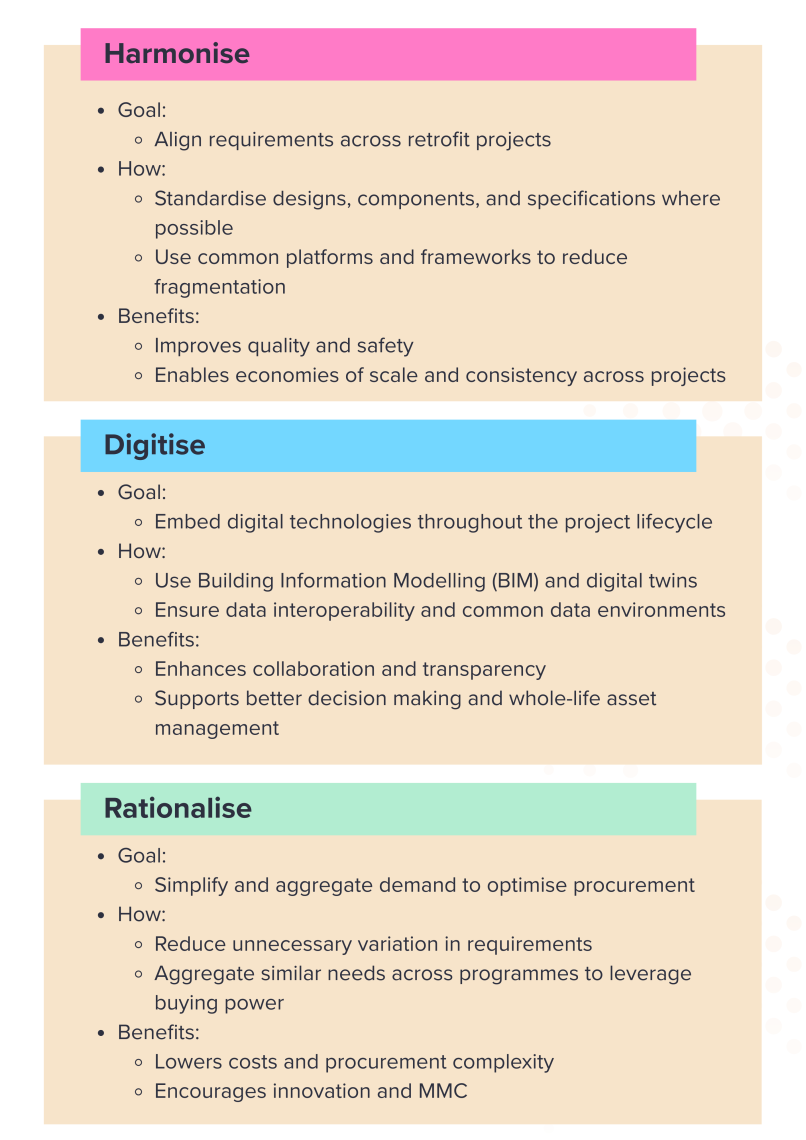
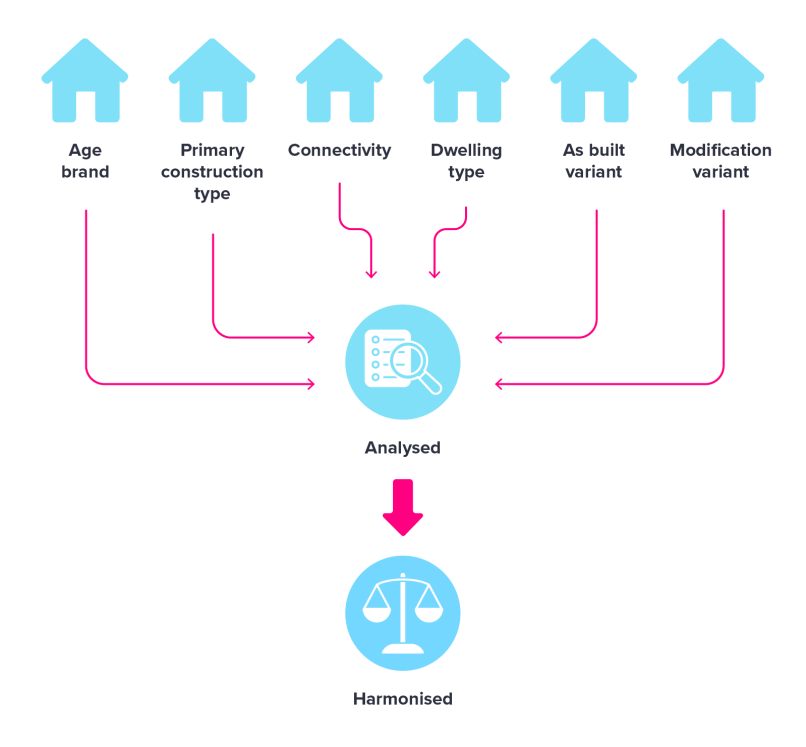
Aggregating the pipeline of future work according to property archetypes allows a targeted and streamlined approach to address the needs of those specific property types.
Harmonising the requirements for retrofit across archetypes enables a more standardised approach to product development, as well as improving the customer propositions through being able to offer clearer options and benefits for their home.
Current state
In its current state the retrofit industry collects building information on a house-by-house basis, meaning there could be more than 29 million data points, each with their own set of requirements for retrofitting. As Transform-ER’s Define the Need report explained, there are significant shortcomings in the capture, storage and centralisation of property data.
EPC data is often the default for building performance information; however, in addition to the questionable accuracy discussed in Define the Need, EPC data does not provide sufficient information regarding the characteristics of a property.
Ambue‘s analysis that shows there is an attrition rate of roughly 30% per stage of a retrofit project – during survey, planning and arriving on-site.
That means that 30% of properties being surveyed could be lost due to problems discovered during the survey, another 30% could be lost due to budget constraints, and another 30% lost when arriving onsite because of complexities and risk of the site for install.
These attrition rates are unsustainably high and can be attributed to the quality of information gathered upfront perpetuating risk and uncertainty throughout the retrofit process.
Future state
In this section, we outline key ideas, approaches, measures and policies for shifting towards a thriving retrofit eco-system that can deliver home energy upgrades at speed and scale. All points are drawn from project research and consortium partners’ experience.
The future state proposed by the Transform-ER consortium is one where the logistics of portfolio-level retrofit are greatly simplified. In the first instance, social landlords should be afforded the ability to choose from a suite of retrofit measures with known and defined interoperability standards. To achieve this, we must follow an Harmonise-Digitise-Rationalise approach.
Transform-ER proposes harmonising requirements through use of standard details and interoperability rules. This standardisation of requirements across projects reduces the complexity of the system and enables a kits of parts approach. The kits-of parts approach enables a design process that is simultaneously flexible and simplified.
A digital marketplace will assist in bringing together demand, client pipelines, and government policy; with supply, new products, processes, and services.
The aggregation of demand will provide the scale and visibility of pipeline to truly reap the benefits of Manufacturing-Led/Industrialised Construction, allowing investment with more confidence by both large businesses and SMEs alike.
The digital marketplace should provide:
- Pipeline analysis to provide visibility of housing demand, allowing industry to identify commercial opportunities, material shortfalls and skills gaps for forward delivery planning.
- Data templates containing technical and performance attributes of approved components and kits-of-parts ready for deployment, enabling sector digitalisation and enabling value-based decision making by clients and greater access to the marketplace for new entrants.
- Generative design tools and AI iterative design tools for rapid solution development of preapproved, standardised components for accurate cost and performance assessment.
- Digital procurement of parts and materials from manufacturers, reducing cost implications and challenges compared to a conventional multi-layered supply chain.
- Performance monitoring and data gathered regarding the performance of components and systems upon installation, creating a feedback loop to further inform decision making.
A holistic, digitised ecosystem that unifies pipeline data, building designs, and offsite manufactured products can yield significant benefits. Seamless demand forecasting, faster approvals and compliance and data-driven decision making enable more efficient delivery of retrofit projects.
Getting from here to there
Questions
- How can we create commercial funding mechanisms to enable advanced surveying technologies to flourish outside innovation grants?
Enablers
- Need for budgeting mechanisms to fund early-stage data collection.
- A “funnel” approach, large initial investment in data to enable efficient downstream delivery.
- Seamless integration of data capture, analytics, and downstream processes.
- Use of data and analytics to build strong business cases for funding.
- Breaking down tenure silos (social housing vs. private) could improve efficiency and create economies of scale by democratising innovation across all property tenures.
Guidelines
- Community engagement and transparency when using surveying technologies like drones.
- Knowledge sharing to improve machine learning and analytics.
Rules
- Compliance with data protection and communication standards.
“We need to emphasise the importance of getting granular morphological building stock data at the start which could help to create this economy of scale and industrialised solution… Where does the money come from to do the initial survey at scale and how do we prove that’s going to be a better way of delivering?”