Current state pains and barriers
Pains
Barriers

Current state
- The transition period from PAS 2035:2019 to PAS 2035:2023 has ended, meaning new retrofit projects must comply with PAS 2035:2023, which introduces stricter and more comprehensive requirements for publicly funded projects.
- Significant capital is invested in dwelling energy-efficiency upgrades. However, performance improvements are rarely measured. Often the output of these upgrades does not meet the expected performance. This can be attributed to:
- Standard values are used to calculate the theoretical savings instead of using quality existing / validated data of properties and products.
- Other factors related to quality of installation execution, operation and user behaviour.
- Impact of unintended consequences that were unforeseen initially.
- Within three months of retrofitting measures being completed, a basic evaluation shall be completed. This includes:
- Evaluating whether intended outcomes have been achieved, and whether any unintended consequences have occurred.
- Ascertaining that client and occupants are satisfied with the outcomes and the process of the retrofit.
- Identifying any points of dissatisfaction.
- Further monitoring and evaluation are only required after the completion of the basic evaluation if it is deemed by the evaluator that:
- Outcomes are significantly different from those intended.
- Unintended consequences of retrofit work are suspected.
- Evaluation plan legally stipulates it is required.
- The evaluator, coordinator or client has specifically requested it.
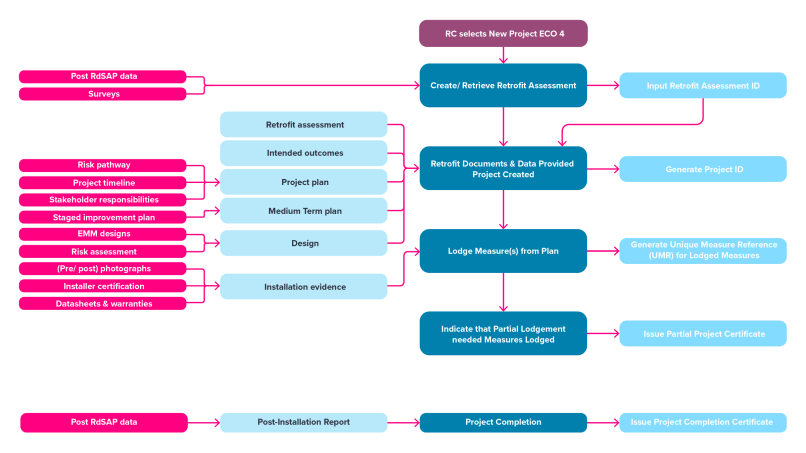
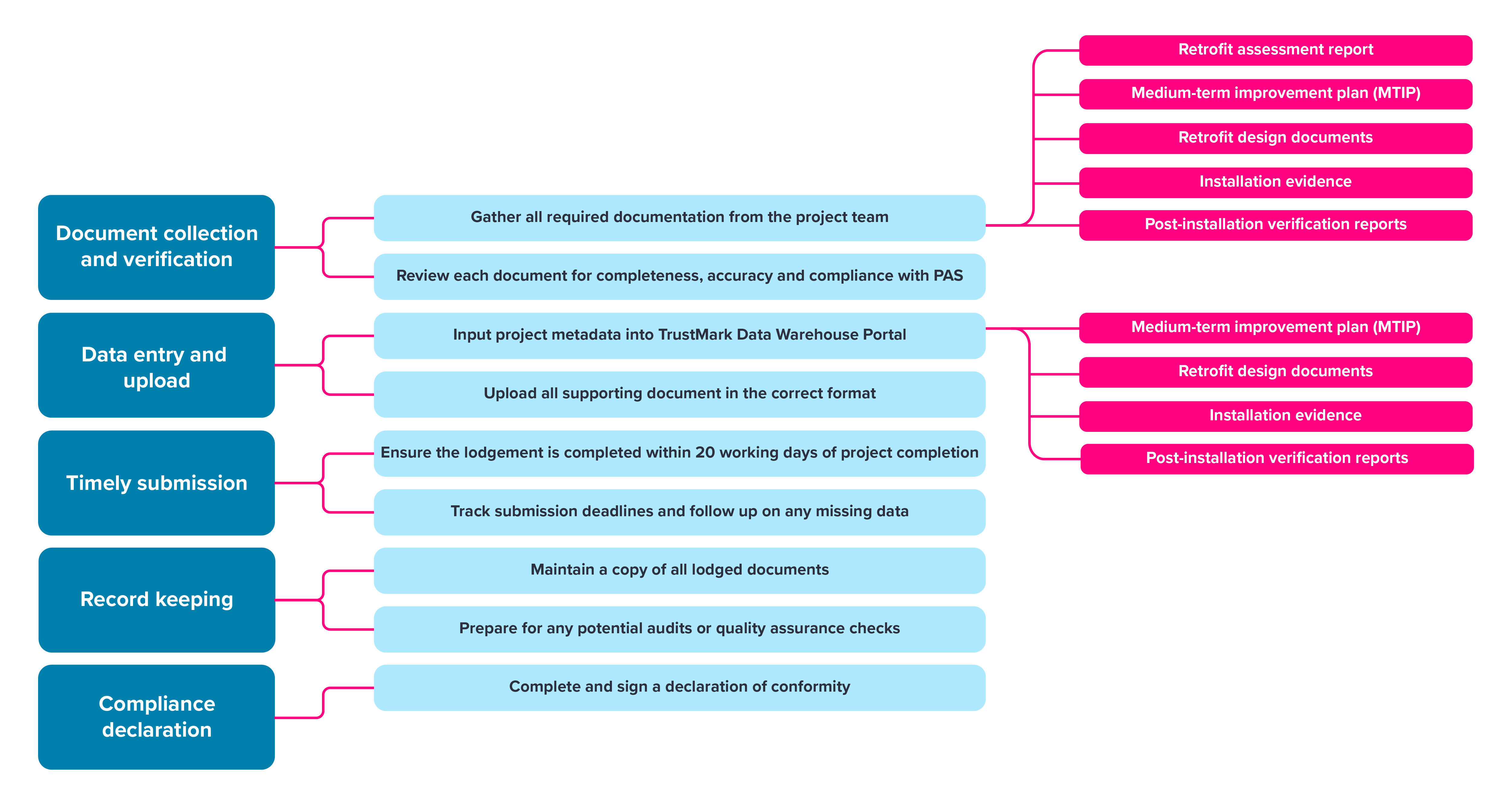
- Trustmark lodgement is a mandatory requirement for all publicly funded retrofit projects (ECO4, GBIS, SHDF and HUG2). It serves as the central mechanism for quality assurance, compliance and consumer protection under the government’s retrofit framework.
- For non-publicly funded retrofits, projects are often not assessed after completion. This means there is:
- No indication of whether the predicted performance meets the actual performance.
- No opportunity to identify and learn from project-specific or systematic problems.
- A retrofit evaluator must have a Retrofit Coordinator qualification to be able to determine if the intended outcomes have been realised.
- Additional qualifications are required to evaluate traditional construction of protected buildings.
- The evaluator shall collate information gathered during the monitoring and evaluation process, and shall circulate the following:
- Summary of information
- Recommendations of any remedial actions required
- Any changes to the retrofit process
- Recommendations for further monitoring and evaluation.
- The Data Warehouse acts as the centralised digital platform in the UK to store, manage and verify data relating to domestic retrofit projects carried out under PAS 2035:2023 standards.
Future state
- The long-term aim of the Data Warehouse is to hold information about work carried out on a property, which would have the potential to become a consumer-facing platform where homeowners can access a property ‘logbook’.
- This facilitates the development of medium to long-term dwelling improvement plans.
- BS 40104 will replace PAS 2035:2023 sections 7.3 and 7.4 and become the new industry standard for post-retrofit installation assessment of domestic dwellings within the UK.
- Increased growth and adoption of third party and integrated monitoring platforms to verify performance from real-time data, enabling detection of unintended consequences such as overheating and condensation, allowing for timely intervention.
- Product performance databases are essential. These will serve as a validated repository of in-use performance for retrofit products, which will bridge the performance gap of theoretical vs actual performance.
- Completion assessments can be used to help validate this data and improve estimate energy calculations prior to retrofit.
Getting from here to there
Enabler
- Future Home Standard shifts the emphasis from theoretical design to real-world operational energy use by encouraging the use of post-retrofit monitoring to validate outcomes.
Key insights
- Microgeneration Certification Schemes (MCS) are needed to allow installers to install EEMs under government scheme initiatives.
- Products require MCS certification as a mark of quality and demonstrates a product’s adherence to recognised industry standards.
Guidelines
Rules
- Transform-ER partners will keep up-to-date and comply with new industry regulations and requirements as stated by PAS 2030, 2035 and Trustmark for completion assessments of retrofit.