
Current state pains and barriers
Pains
- There is an inherent lack of detailed information required to build an accurate pipeline of demand.
- Publicly available housing data is limited and has countless data deficiencies which can lead to poor decision making.
Challenges
- Skill shortage in retrofit pipeline analysis.
- There is no UK standardised approach used for archetyping a dwelling. As such, there is fragmented and inconsistent data on the housing stock in the UK.
Overview
An ‘archetype’ is a typical example of something. This section discusses the benefits of ‘archetyping’ or creating ‘typical examples of houses’ when it comes to retrofitting.
Our definition of a property archetype refers to a typical example of a property subject to energy rehabilitation measures. An archetype is defined by a series of characteristics.
All homes that share these characteristics can, by extension, be added to the pipeline and be subject to renovation with known expected outcomes.
The more characteristics defined, the greater the definition of the archetype, leading to greater similarity with the homes added to the pipeline but a smaller number of such homes.
Current state
A retrofit assessment for properties is mandatory for all properties going through the retrofit PAS2035 process. Assessments aim to identify opportunities for energy efficiency improvements; determining the most suitable Energy Efficiency Measures (EEM) for each surveyed dwelling. The current process to gather information about properties for retrofitting solutions involves several key steps:
- Occupant assessment: Evaluates the needs and behaviours of the building’s occupants to ensure the retrofit measures will be suitable and beneficial.
- Condition survey: A detailed inspection of the building’s existing structure, including heating, ventilation, and insulation systems.
- Energy report: An analysis of the building’s current energy performance and areas where improvements can be made.
For more information, visit the Energy condition assessments section.
Gathering data on a case-by-case basis is tedious and inefficient and it hinders the potential of creating clear aggregated demand. To understand and calculate the potential aggregated demand for retrofitting solutions, the following approaches are often used:
- Market analysis: Conducting surveys and studies to understand the demand for retrofitting solutions across different regions and dwelling types. This helps identify trends and potential areas with high demand.
- Pilot projects and case studies: Implementing pilot projects to gather data on the effectiveness of retrofitting solutions and their acceptance by property owners. These projects provide valuable insights into the potential aggregated demand.
- Stakeholder engagement: Engaging with property owners, local authorities, and industry stakeholders to gather feedback to understand their needs and preferences. This helps in tailoring retrofit solutions to meet market demands.
An alternative approach is needed to judge every project on a case-by-case basis, if an accurate pipeline is to be determined for retrofit at scale.
There have been attempts to simplify the understanding of the housing stock and the UK’s retrofitting potential, including:
- LETI’s Climate Emergency Retrofit Guide: In this case, a series of house archetypes were developed based on average data for different building types to define the energy use targets for each representative example.
- National Retrofit Hub (NRH) Archetypes Library and Best Practice guide: The NRH recently recognised ‘archetyping’ as a powerful tool to understand or segment building stock:
- Archetypes library: provides the wider sector with access to existing archetype guidance created by designers, local authorities, and property owners.
- Archetypes Best Practice Guide: assists those identifying archetypes and designing retrofit interventions based on archetypes to achieve high-quality results tailored to their specific use case.
Future state
In this section, we outline key ideas, approaches, measures and policies for shifting towards a thriving retrofit eco-system that can deliver home energy upgrades at speed and scale. All points are drawn from project research and consortium partners’ experience.
Transform-ER has adopted the Construction Innovation Hub’s Demand > Develop > Deploy structure. The ‘Demand’ phase involves identifying market demand and understanding the needs that industrialised retrofit solutions aim to address.
“Through the use of platforms – common, repeatable assets with interoperable components – [our rulebook] aims to drive a new market for manufacturing in construction, to provide a predictable pipeline of demand that affords industry the confidence to invest in new products and technologies and to create stable and inclusive employment where jobs are most needed.” Construction Innovation Hub’s Product Platform rulebook
To have a predictable pipeline, the use of archetypes is key. Transform-ER’s Define the Need report introduced the benefits of targeting a group of homes with common features represented by the ‘archetype’, to simplify and scale up retrofitting and provided the first industry definition.
Defining an archetype in a retrofitting project can deliver benefits including:
Improved forecasting of the project pipeline
- Predictable outcomes
- Scalable planning
- Prioritisation of projects
Modelling archetypes instead of all homes in the first instance
- Cost-effective modelling
- Reduction in complexity
- Consistency
- Enabling more private capital
- Appropriate ‘net-zero pathways’ selection
Selection of optimum targets and technical solutions
- Targeted solutions – suitable products and kit-of-parts
- Compensation for variability
- Flexibility in implementation
Data-driven decision making
- Data collection & analysis
- Learning from similar homes
Facilitates stakeholder communication and engagement
- Clear communication
- Strategic partnership
- Finance products
- Delivery risk
See below for a deep dive on how to build an archetype.
How to get from here to there
Questions
- Does a British Standard need to be developed for archetyping?
Enablers
- New digital tools that can support portfolio analysis, management and demand aggregation.
Guidelines
- The more categories defined by a project, portfolio or consortium, the greater understanding of the pipeline of demand for stakeholders.
Deep dive: how to build an archetype
While the definition of an archetype depends on the final interest of the organisation that uses it, here’s our approach:
1. Identification of categories
These are the selected characteristics that properties must have to be represented by the archetype. These categories usually involve common construction features that would have an impact on the energy performance, the retrofitting potential or other, especially when these data are crossed with other available information.
2. Archetype definition
The different archetypes can then be defined by using the different categories and which combination fit the specific scope or use case. Variants may exist. There may be subtypes whose variations do not imply a significant departure from the archetype’s fundamental nature.
Understanding the archetyping to which a property is part of, along with the dwelling specific characteristics and the net-zero pathways, will ease retrofitting at scale.
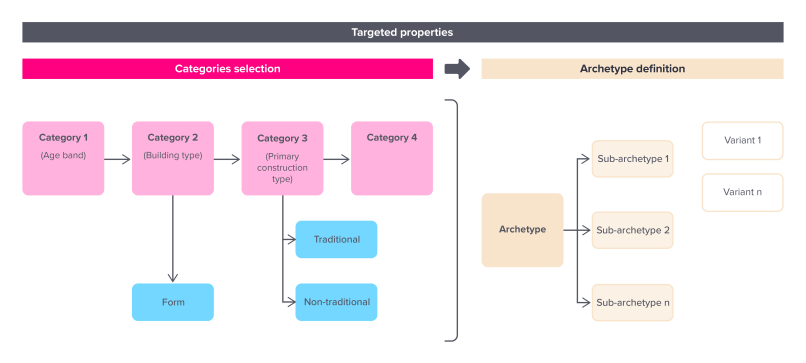
Archetype data schema
- Age band
- Primary construction type
- Connectivity
- Dwelling type
- As built variant
- Modification variant