Defining what constitutes a “kit-of-parts” for Transform-ER is essential to achieving retrofit at scale through an Industrialised or Manufacturing-Led approach.
And it is crucial to articulate how these definitions relate to the interoperability of products and the implementation of Energy Efficiency Measures across dwelling portfolios.
Here’s what some of the common terms we use throughout the chapter mean.
Definitions
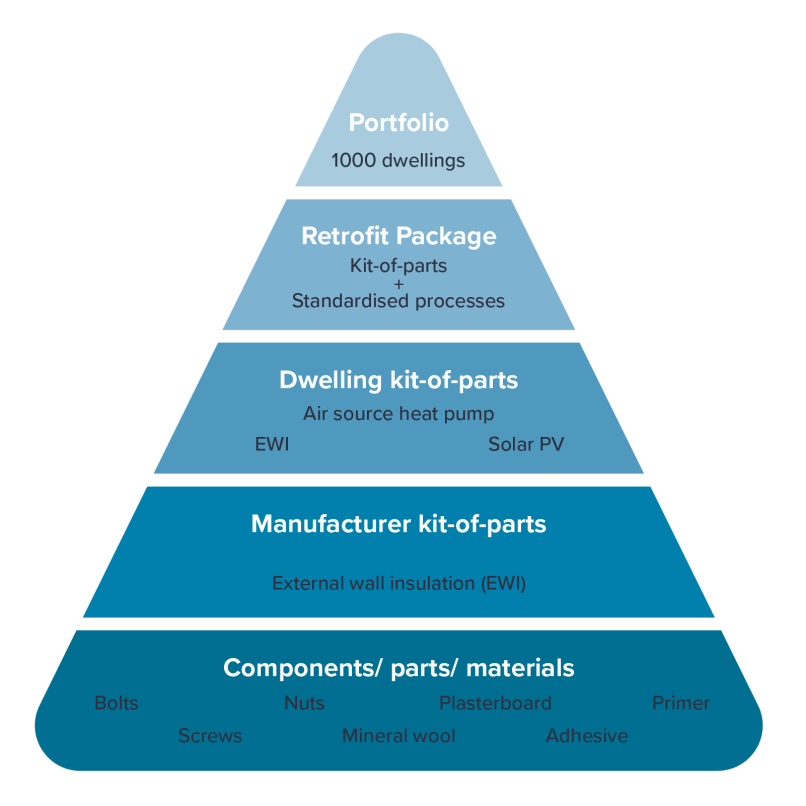
| Kit-of-parts: new build | A collection of repeatable, standardised building components that are pre-engineered and designed to create a variety of assemblies which define part or all of a finished building. |
| Kit-of-parts: retrofit | A collection of repeatable, standardised retrofit components that are pre-engineered and designed to create a variety of retrofits. This includes standardised interface details, enabling interoperability of Energy Efficiency Measure (EEM) solutions, different manufacturer products, and mass customisation for retrofit at scale. |
| Retrofit package | The combination of kits-of-parts and associated structured information, stakeholder roles and responsibilities, an outline business case detailing known outcomes, and contracts and/or agreements. The retrofit package also includes standardised processes/products for finance, insurance, contracts, procurement, and certification as part of the packaged retrofit offering to the customer. Level 1 – as above, technical and organisational information Level 2 – Retrofit package is financed, insured and certified. Contractual and procurement processes are standardised. |
| Dwelling kit-of-parts | – Every product, system, measure, component or part required to deliver a whole house retrofit as part of a portfolio of properties. – The dwelling kit-of-parts includes structured information linked to the physical parts. – The dwelling level kit-of-parts is the combination of multiple manufacturer’s kit-of-parts. Note: To maximise repeatability and harness the benefits of standardisation, all dwellings in a given portfolio of properties should be of the same archetype |
| Manufacturer kit-of-parts | Every product, system, measure, component or part included as part of a manufacturer’s retrofit offering. The manufacturer’s kit-of-parts includes structured information linked to the physical parts. |
| Structured information | – Product information. – Deployment information. – Organisational information, including capability and credibility. |
| Interoperability | The degree to which two products or programmes can be used together, or the quality of them being able to be used together. |
| Retrofit interoperability | The degree to which two or more retrofit measures can be used together, or the quality of them being able to be used together as part of a dwelling level kit-of-parts. |
The hierarchy of retrofit kit-of-parts is shown below.
Supply chain interoperability example
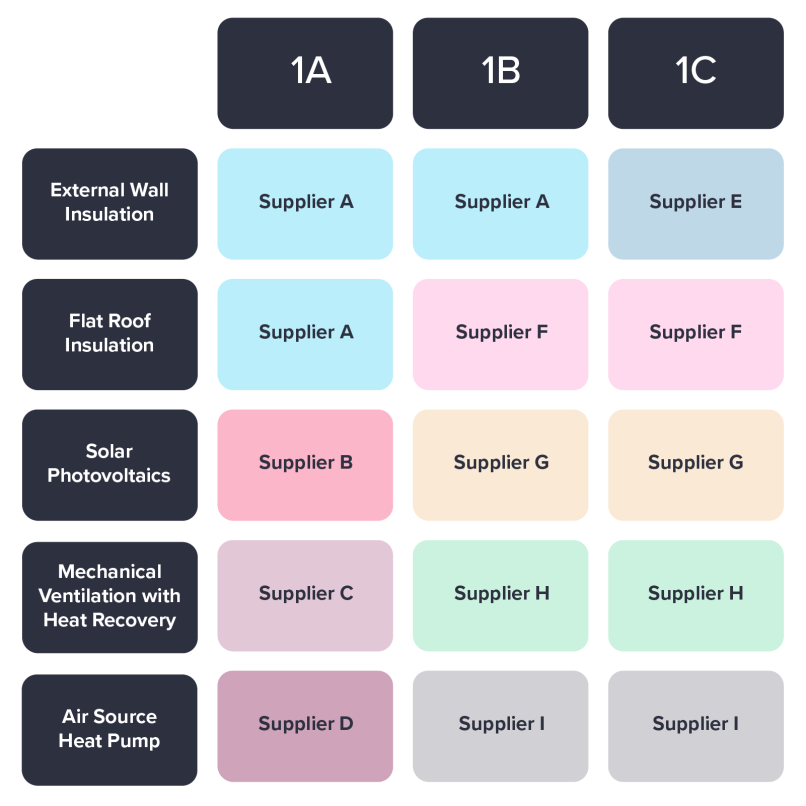
Portfolio 1: Wimpey No-Fines with 5 archetype variants
- 1000 properties
- 400 properties prioritised for optimal cost (1A)
- 400 properties prioritised for optimal energy efficiency performance (1B)
- 200 properties prioritised for heritage aesthetic (1C)
Down selected PAS Energy Efficiency Measures (EEMS)
- Flat roof insulation
- Air source heat pump
- External wall insulation
- Mechanical ventilation with heat recovery
- Solar photovoltaics
An example of interoperability for a retrofit kit-of-parts at portfolio level is shown below