

Overview
Whole house retrofit requires the design and management of Energy Efficiency Measures (EEMs) and interfaces, across multiple stakeholders.
Due to the complex nature of whole house retrofits, PAS 2030 and PAS 2035 were published to provide open source guidance and defining standard roles, such as:
- Retrofit designer
- Retrofit assessor
- Retrofit coordinator
- Retrofit installer
“There is a risk of complacency in the specification, design and installation of EEMs in multiple similar dwellings, which can lead to poorly designed and executed works being repeated across many dwellings.”
Challenge for retrofit at scale
- The industry needs a robust method of managing the roles and responsibilities involved in deploying interoperable kits-of-parts across multiple interdependent supply chain partners, at portfolio level.
- The workflow below is one suggested method that could be adopted for retrofit at scale, to be trialled further, beyond the Transform-ER project.
- Future considerations that Transform-ER has outlined to consider in the Develop and Deploy phases include:
- Building Information Modelling (BIM), including defining BIM execution plan.
- Future requirement for design data quality assurance / BIM co-ordination role?
- Level of detail defined at each stage of the design process – what is the minimum standard for a kit-of-parts?
Roles and responsibilities
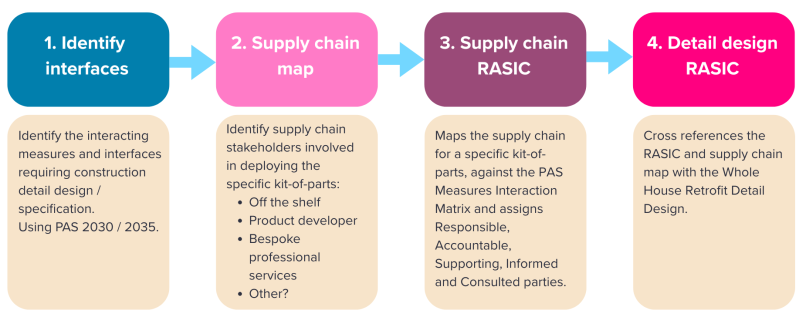
Step 1 – Identify interfaces
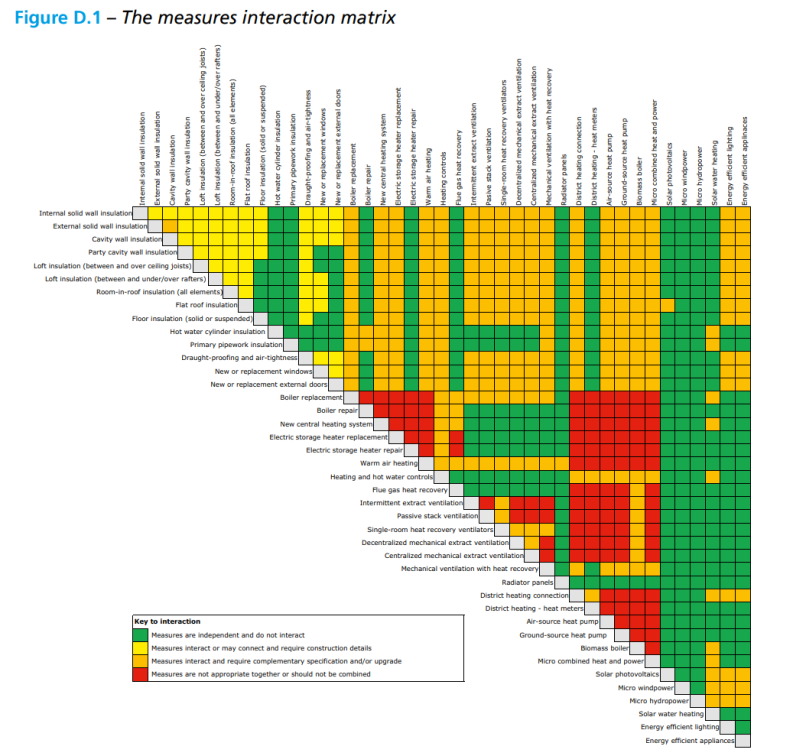
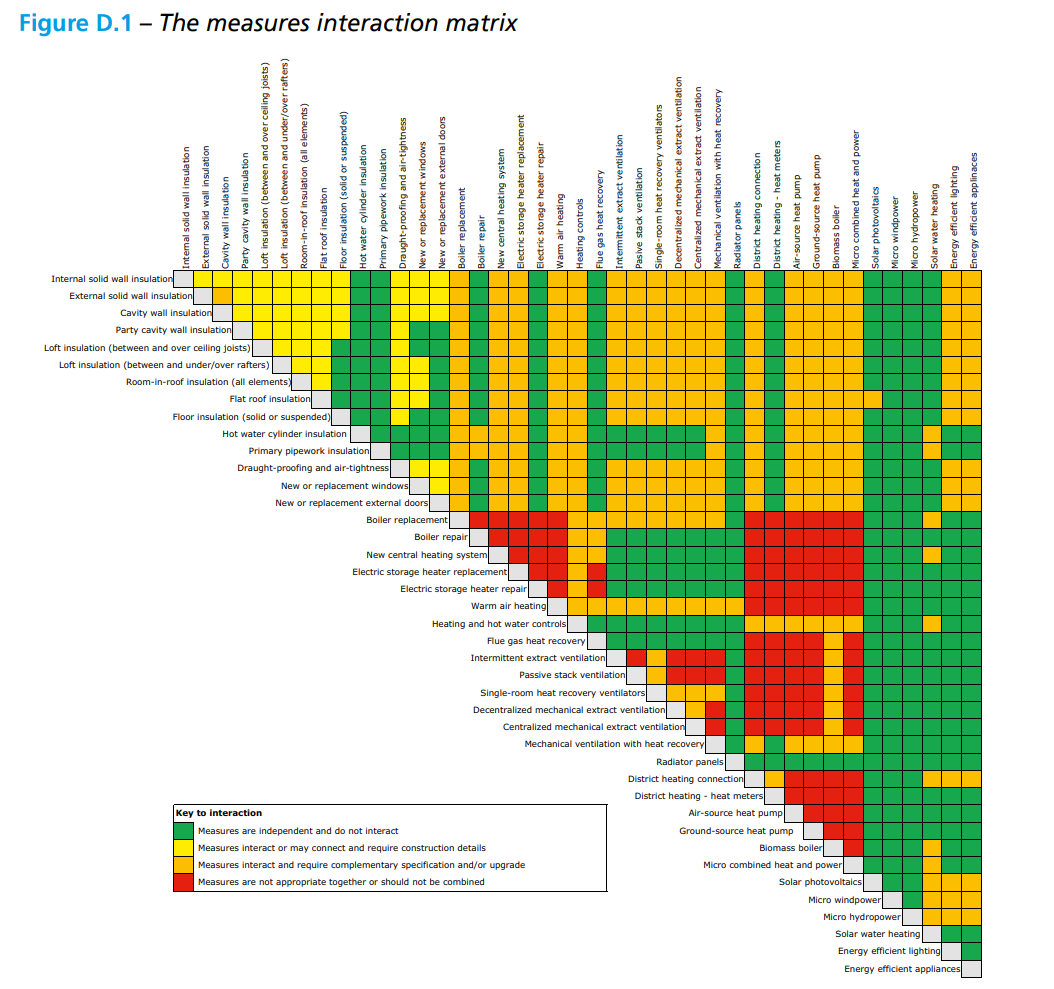
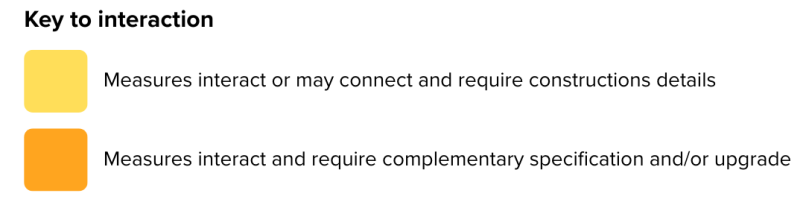
- Once the EEMs have been selected, a more in-depth assessment of the measures Interaction Matrix should be developed using PAS 2035
- Green and Red Interfacing EEMs can be omitted for this exercise
- Orange and Yellow Interfacing EEMs selected for the portfolio can be taken forward for further review
Step 2 – Supply chain map
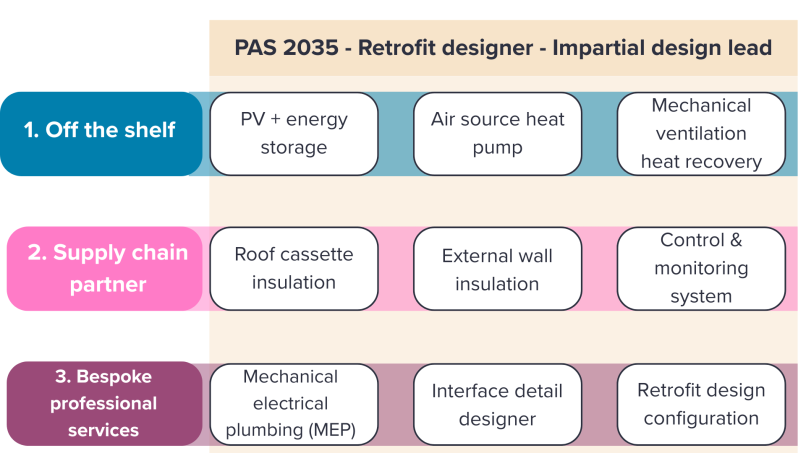
Create a simple supply chain map diagram:
- Off the shelf products
- Product design developed for specific portfolio by supply chain partner
- Bespoke professional services
Step 3 – RASIC
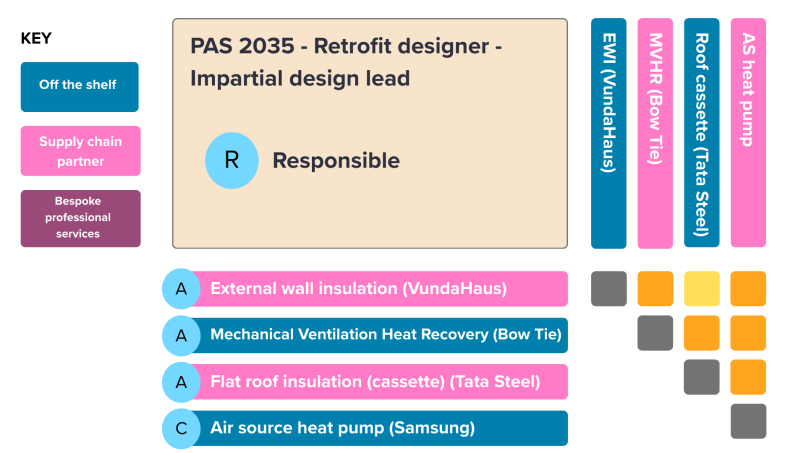
Develop a RASIC using the Identified interfaces and Supply chain, from Step 1 and 2.
R – Responsible
A – Accountable
S – Supporting
I – Informed
C – Consulted
- The PAS 2035 Retrofit Designer should act as impartial design lead, pulling together the design of the retrofit package, from the down selected kit-of-parts and supply chain partner organisations.
- Every Measures Interaction Interface must have an Accountable organisation /person assigned to it.
Step 4 – Detail design RASIC
- Once design e.g. RIBA Stage 3 or 4, roles and responsibilities are mapped within the retrofit project team and supply chain – specifically for the interfaces of the retrofit.
- Use of design software – with the capability to manage and assign roles and responsibilities within the detail design of the whole house retrofit – is critical to deploying interoperable kits-of-parts for a portfolio of multiple properties.
- Examples of software tools include Procore and Revit Worksets, other software solutions are available.
- This enables roles and responsibilities / use of a RASIC to be referenced within a Design Management System.