

Interface definition
A concave wall in a residential building refers to the walls that meet at the intersection of two perpendicular walls, forming the corner of a room or the building’s exterior. Concave walls are crucial for both the structural integrity and aesthetic design of a home.
Considerations for convex walls include:
- Structural design: Capable of transferring loads and stresses particularly in multistorey buildings.
- Insulation and energy efficiency: Proper insulation to prevent thermal bridging and heat loss.
- Water and weatherproofing: Adequate sealing and flashing required to prevent water ingress.
- Aesthetic integration.
Interface requirements
Critical requirements for a concave wall interface were summarised as follows:
- Low-cost, widely accessible details for Transform-ER.
- Must act as a connection detail between EWI and the existing property.
- Must keep in line with fire regulations and UK building regulations.
- Prevent damp/moisture ingress into the property.
- Ensure insulation and thermal properties are continuous across the interface.
Interface categorisation
- Insulation risk
- Structural risk
Interface rules
The following are critical high-level rules for a concave wall detail that should be complied with as part of a Transform-ER retrofit programme:
- If space permits, use a Mullion to avoid starting and stopping EWI system.
- Avoid moving window or door opening where possible.
- Shrinking opening by around 150mm is preferred action.
- If opening is a fire escape or will be decreased to below building regulation size preferential route is to utilise a thinner bespoke EWI section in corner region to minimise onsite time, cost and disturbance.
Exemplar detail
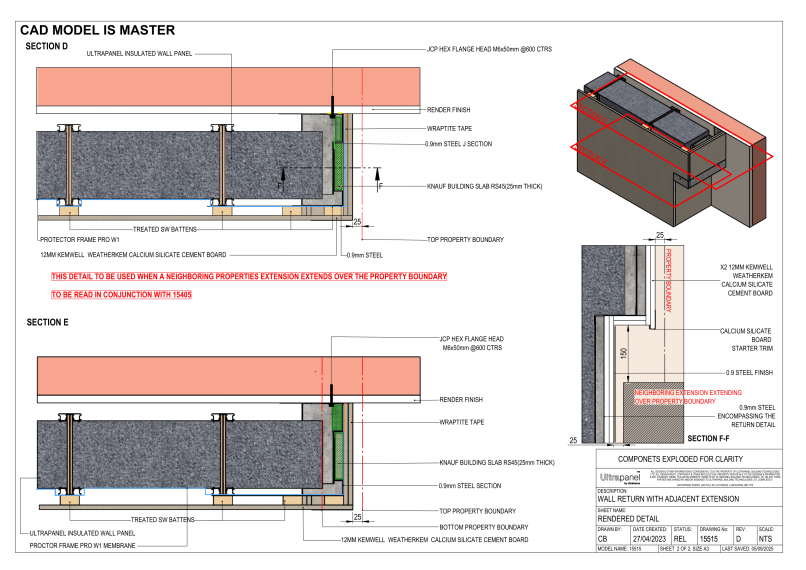
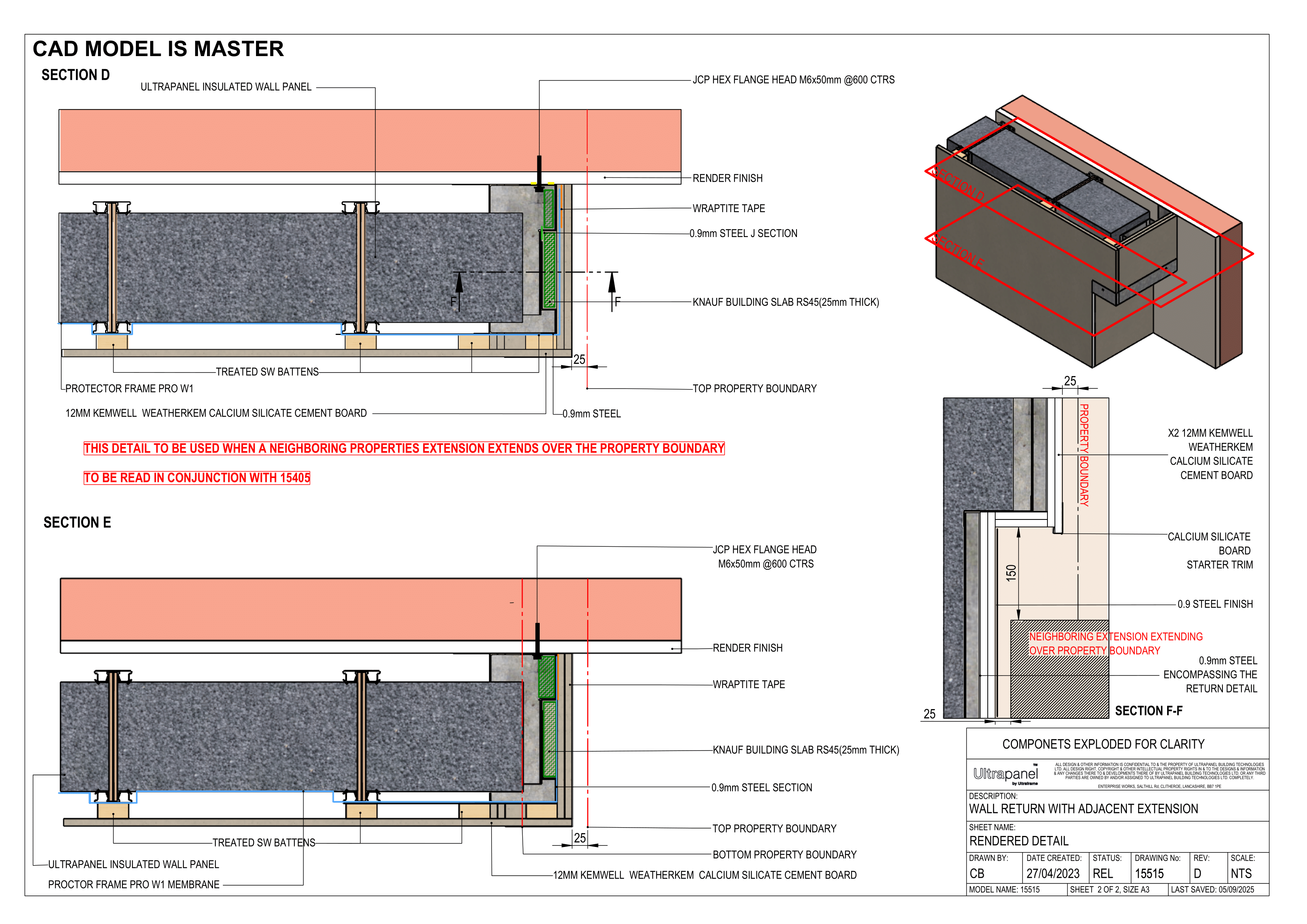
Below is an example of how Ultraframe’s system tackles a concave wall interface and the steps/procedure put in place to ensure weather tightness, insulative properties and fire resistance are maintained:
Testing and validation
It is important that the system provider considers how the external wall system will accommodate concave wall interfaces to ensure system performance (thermal, structural, and weathering) is maintained. Concave interfaces often pose greater risks than flat walls due to limited access, geometry-induced stresses, and challenges in achieving continuity of insulation and finish.
Concave junctions – such as recessed corners, alcoves, internal returns, or enclosed courtyards – are critical areas in retrofit systems. If not carefully detailed, these can become thermal bridges, sites of water ingress, or structural weaknesses. This section supports manufacturers and installers in designing and validating robust detailing strategies for concave interfaces in domestic retrofit contexts.
Develop standardised detailing packages
Concave wall interfaces are often visually concealed but technically complex. These junctions may trap moisture, create shading effects, and restrict access during installation. Without proper detailing, they can underperform thermally and suffer from damp or movement-related issues. Manufacturers should pre-emptively design standardised solutions for typical internal angles and recessed areas.
Common concave junctions to consider include:
- Internal corners of terraced or semi-detached houses.
- Recesses behind extensions or lean-tos.
- Alcoves formed by L-shaped floorplans.
- Enclosed porches or rear returns.
- Gaps between closely abutting buildings.
Key considerations:
- Alignment and continuity of insulation in tight angles.
- Ensuring render or cladding materials are applied without voids or bridging.
- Risk of moisture accumulation due to poor ventilation or trapped water.
- Access limitations during installation and future maintenance.
Generic details and guidance are available in INCA Technical Guidance Document 06.
Design detail validation
Structural durability
- Concave corners are subject to stress concentrations and may be difficult to reinforce post-installation. Reinforcement strategies may require:
- Flexible corner mesh and render systems that accommodate movement.
- Additional fixings or support battens in narrow or deep recesses.
- Verification of fixing patterns using BS EN 1991-1-4 and EAD 040083-00-0404.
Thermal performance
- Concave junctions can create thermal shadows and areas of restricted airflow, increasing the risk of condensation:
- Psi-value modelling as per BS EN ISO 10211, BR 497, and BRE IP 1/06 should be undertaken to assess thermal bridging.
- Moisture Performance – Internal angles are prone to:
- Water retention due to poor run-off.
- Lack of sunlight leading to drying delays and biological growth.
- Detailing should include sloped finishes, weep channels, and sealed joints to prevent ingress.
- All systems must demonstrate compliance with ETAG 004 for water absorption and freeze-thaw resistance.
Relevance
- Concave junctions are common locations for cold spots, particularly in properties with extensions or irregular geometry.
- Condensation and mould risk is elevated due to limited sun exposure and ventilation.
- Improperly meshed or sealed internal corners are prone to cracking and delamination.
- Poor detailing can affect fire compartmentation and vapour control continuity.
Site validation
Post-installation inspections are essential to confirm the design intent has been met:
- Use thermal imaging (BS EN 13187) to detect potential thermal bridges or voids in corners.
- Check all internal angles for full insulation coverage, render integrity, and joint sealing.
- Where feasible, perform moisture checks in recessed areas using surface hygrometers or embedded sensors.