
News24th February 2026
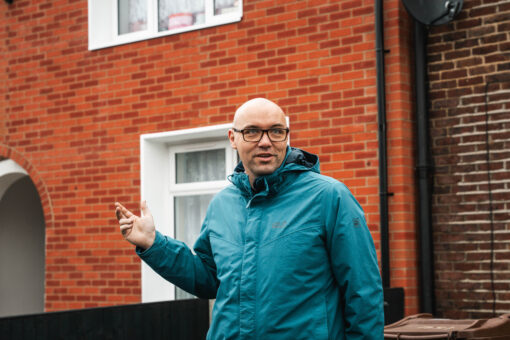
For our final Meet the Transform-ER’s interview, we have something slightly different.
In December, Transform-ER delivered its first demonstrator home on the UK’s largest social housing estate in Barking and Dagenham funded by Innovate UK, Thames Freeport and delivery partners.
Designed and delivered by Bow Tie Construction, it used Ultrapanel Building Technologies’ next generation external wall insulation (EWI) with integrated ventilation, plumbing and renewable energy generation to create a full home retrofit solution. This included personalised improvements guided by tenant-focused engagement.
Here Rafael Delimata from Bow Tie Construction (one of the founding members of Transform-ER) shares the story behind the project and how against all odds the highly collaborative team managed to deliver a kit-of-parts retrofit in 4 weeks and at half the cost of previous projects – while taking the home from an EPC D to a projected A.
The story of Transform-ER demonstrator home – told by our ‘retrofit realiser’
If you had told me at the start of this project that we would deliver a complete retrofit demonstrator in Becontree in four weeks, in November, with minus five degree temperatures, relentless rain, blocked sewage spilling over the garden, and a funding deadline bearing down on us – I would have raised an eyebrow. But we did it. And more importantly, I know exactly why we did it.
This is the story of how everything that could go wrong at the start went wrong, and how a different approach to planning, collaboration, and cost management turned what could have been a disaster into one of the most satisfying projects of my career.
This is the story of one of the most satisfying projects of my career.
Starting on the back foot
The original plan was to start in summer. That did not happen. By the time we finally mobilised, it was November – the worst possible time to be working outside in the UK. The time required to complete the design got squeezed to four weeks. Then came the pressure of the funding cycle and our project Transform-ER reaching the end of its term, which meant we had precious little time to gather feedback and measure performance after delivery.
We had to deliver before Christmas. The weather had other ideas. Minus five degrees. Horrendous rain throughout. We abandoned the site three times. On paper, it looked like a project destined to overrun, overspend, and underdeliver.
We abandoned the site three times. On paper, it looked like a project destined to overrun, overspend, and underdeliver. We proved that wrong.
The trick that changed everything – prep work and a buffer
The first big shift in thinking was in how we structured the work. Rather than treating the project as a single continuous run from start to finish, we split it into two distinct phases: prep phase, followed by a deliberate four-week buffer, and then the main works phase.
That buffer turned out to be invaluable. A lot happened inside it. When back garden flooded with sewage, we were able to deal with it without it cascading into scaffolding delays or knocking back our rear elevation works. The buffer absorbed the shock.
It also allowed us to carry out all ground works and testing of existing electrics and plumbing to avoid any surprises during the main works phase.
More than that, the prep phase gave us time to do proper reviews with the resident. That mattered enormously
More than that, the prep phase gave us time to do proper reviews with the resident. That mattered enormously. It was during this time that we discovered real problems that the residents were living with but had not formally raised – issues that our early design had not accounted for.
For example, very low water pressure which meant the boiler didn’t work very well and there was virtually no storage. For a mother of a three, this is not a minor inconvenience.
Once we understood the situation, we made the decision to include these fixes in the scope. It was the right call, and we could only make it because we had built in the time to listen.
Four weeks on site – collaboration in action
When the buffer ended and we moved into the main delivery phase, everything ran on a tight but realistic timeline. Four weeks, start to finish. The key to making that work was not just having a project management tool – though everyone having their own deadline in the system absolutely helped – it was the quality of collaboration between trades on the ground.
The supplier was onsite making adjustments to their system in real time. The plumber, the electrician, and the solar PV team were working alongside each other, not in sequence. When one supplier needed some extra cable, another handed it over because they knew it would get things done quicker and they were all working with a shared purpose. Small things, fast decisions, no bottlenecks.
The result: we finished in the first week of December. Everything done. Four weeks, as planned.
When one supplier needed some extra cable, another handed it over because they knew it would get things done quicker and they were all working with a shared purpose.
Cost management through coordination, not cuts
The second major success of this project was cost control – and it did not come from squeezing margins or cutting scope. Information was exchanged during 4 weeks of design and then refined after prep phase, with 4 weeks buffer to get it right.
The second major success of this project was cost control – and it did not come from squeezing margins or cutting scope.
In a typical project, you see this pattern: insulation goes in, then the PV installers arrive and discover they cannot route cables where they planned to, so now you need metal ducting on the front elevation and the cost has jumped. It happens constantly. It happened to us on previous projects.
This time, we ran a live design conversation between all parties during the prep and buffer phase. Multiple emails were exchanged: here is the proposed design, here is the ventilation specialist’s response, here is the PV installer’s view, back to the manufacturer.
When it turned out that Ultrapanel’s wall panels needed to shift by 50mm to allow two electrical ducts to sit behind them – rather than being exposed on the elevation – that was resolved in email before it became a costly problem onsite.
We still encountered a handful of issues during the installation, but the budget did not move. We booked six weeks for delivery and finished in 4.
A light touch inside, a transformation outside
It is worth being clear about what we actually did – and what we deliberately did not do. All the substantive work was external. We removed old cables and pipes as well as a rusted satellite dish and worked around what the resident was actively using (internet connection), and made a series of small, smart decisions as we found things.
An old internet cable hanging off the façade: gone, once confirmed it was not in use. A leaking tap was replaced with a new anti-frost tap situated so that the external wall insulation could be installed without another plumber visit. The electrician audited the lighting, power and fire alarm while they were there. Spotlights and energy efficiency fittings were assessed and upgraded where needed.
None of these were big jobs. But they were the kind of thoughtful, joined-up thinking that distinguishes a good retrofit from a box-ticking exercise. The resident noticed. The house was better prepared for the system we installed, and the system was installed to fit the house as it actually was – not as it appeared on the early drawings.
Why this felt different
I have worked on earlier projects with the same team. Some of them took significantly longer. Some cost double. And the feedback at the end was not uniformly positive. There were lessons we needed to learn, and honestly, it took those harder experiences to understand what needed to change.
This is the first project where I have walked away feeling genuinely satisfied. The conditions were against us from the start. We delivered anyway. And the way we delivered feels like something that can be repeated, scaled, and built upon.
That, ultimately, is what a retrofit demonstrator is for. Not just to prove that one house can be improved, but to prove that the method works. I think we proved that.
This is the first project where I have walked away feeling genuinely proud. The conditions were against us. We delivered anyway. And the method feels ready to scale.
Our key lessons
Here’s what our demonstrator showed in action – and the principles we will be using to scale our approach further.
- Plan in phases, not one continuous run. Separating prep work from the main installation – with a deliberate buffer in between – absorbs the unexpected and creates space for genuine resident engagement.
- Coordinate trades before mobilising, not after. Cross-trade design conversations in advance prevent the costly surprises that typically inflate budgets onsite.
- Listen to the residents who live there. Early design phases rarely capture everything. The prep phase is your best opportunity to find out what is actually wrong with the house – and make often quite simple fixes while you are there. This builds enormous goodwill.
- Give everyone a deadline, a tool to track it and the freedom to work together to achieve it. Simple project management, consistently used, keeps every trade accountable without adding bureaucracy.
Read our full case study, or find out more about Transform-ER’s bold new approach to retrofit delivery.
This blog is adapted from a panel session at Transform-ER’s showcase event in Barking and Dagenham on 11 February 2026.